
5 Warning Signs Your Factory Has an AI Safety Blind Spot
In manufacturing, "safety first" is no longer just a slogan on a breakroom poster. It is a data-driven mandate. Yet, despite rigorous safety protocols, intensive training, and heavy investments in compliance, severe incidents still happen.
Having spent over 30 years leading plant operations, I've walked countless production floors and seen many types of safety challenges firsthand. I know how fast a routine shift can turn sideways, and I understand the deep weight of responsibility that comes with keeping a team safe. According to OSHA's Top 10 Most Cited Standards, violations regarding machine guarding, lockout/tagout (LOTO), and personal protective equipment (PPE) consistently rank among the top industrial infractions year after year. These aren't just regulatory headaches; they are the exact vectors where catastrophic injuries occur.
If your facility is relying on traditional, manual oversight to manage these risks, you don't just have a compliance gap, you have an AI safety blind spot. Even if you have already begun introducing artificial intelligence into your facility, not all AI safety solutions are created equal. Passive monitoring and delayed analytics won't stop an accident in real time.
Here are five critical warning signs that your factory is suffering from an AI safety blind spot, and how a proactive worker safety AI camera system powered by continuous AI safety monitoring can bridge the gap before the next shift begins.
Warning sign 1: safety data that is entirely reactive (TRIR, DART, incident reports)
If your primary safety metrics consist of Total Recordable Incident Rates (TRIR), Days Away, Restricted, or Transferred (DART), and post-incident investigation reports, you are managing safety through the rearview mirror.
While historical data is necessary for compliance, it does nothing to prevent the accident that is about to happen on the shop floor right now. Traditional video surveillance setups often compound this issue. Hundreds of camera feeds stream into a security room where a single guard, or a wall of unmonitored monitors, records the day's events. When an incident occurs, teams spend hours pulling footage to see what went wrong.
The AI Approach: Video-to-Action Real-Time Alerts
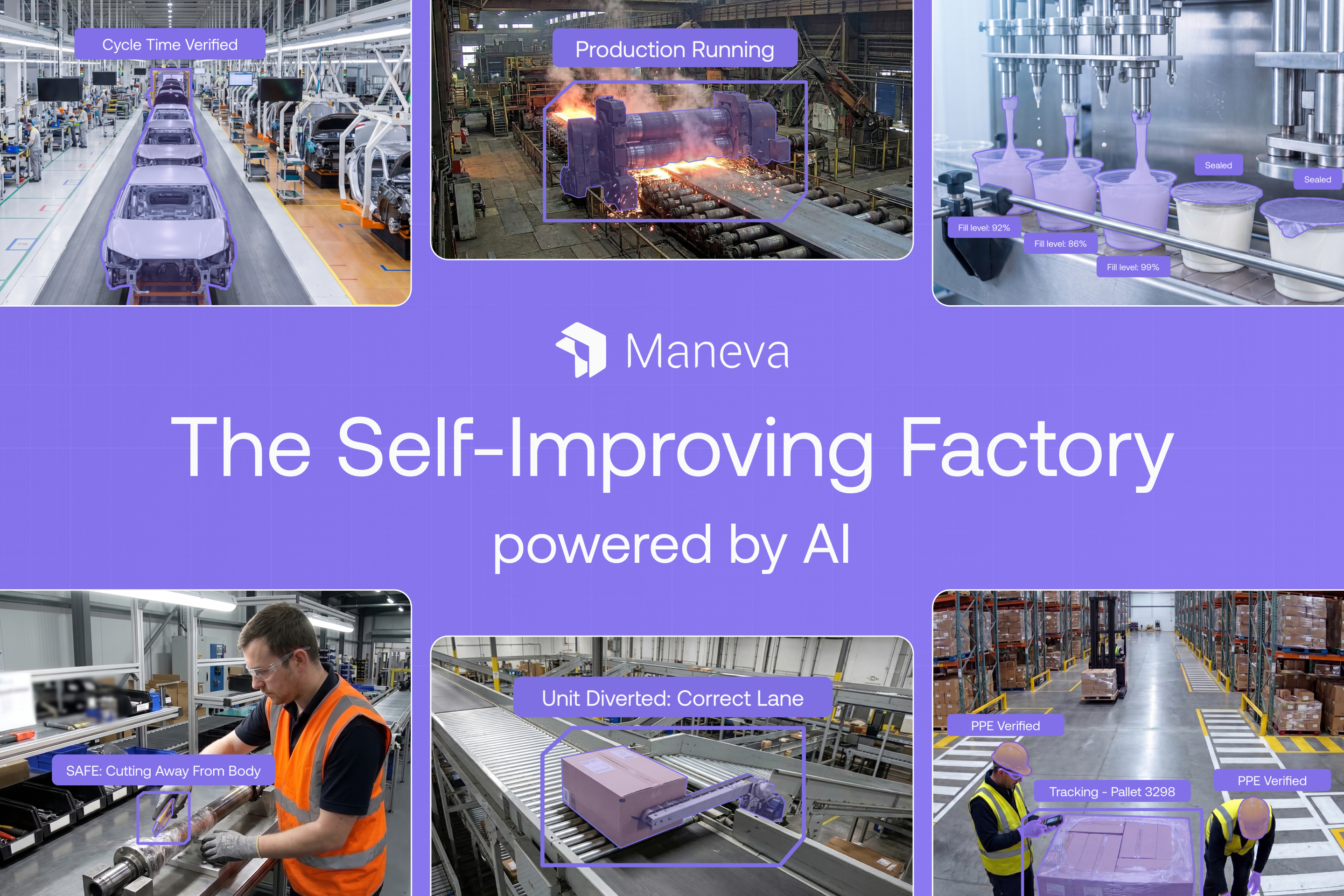
An advanced AI factory safety monitoring system transforms your existing cameras from passive recording devices into active, digital safety supervisors. Maneva's ALIS (AI Line Supervisor) agent analyzes live video streams frame-by-frame, so instead of reviewing footage after a worker slips or gets caught in a machine, the system flags the hazard the moment it appears.
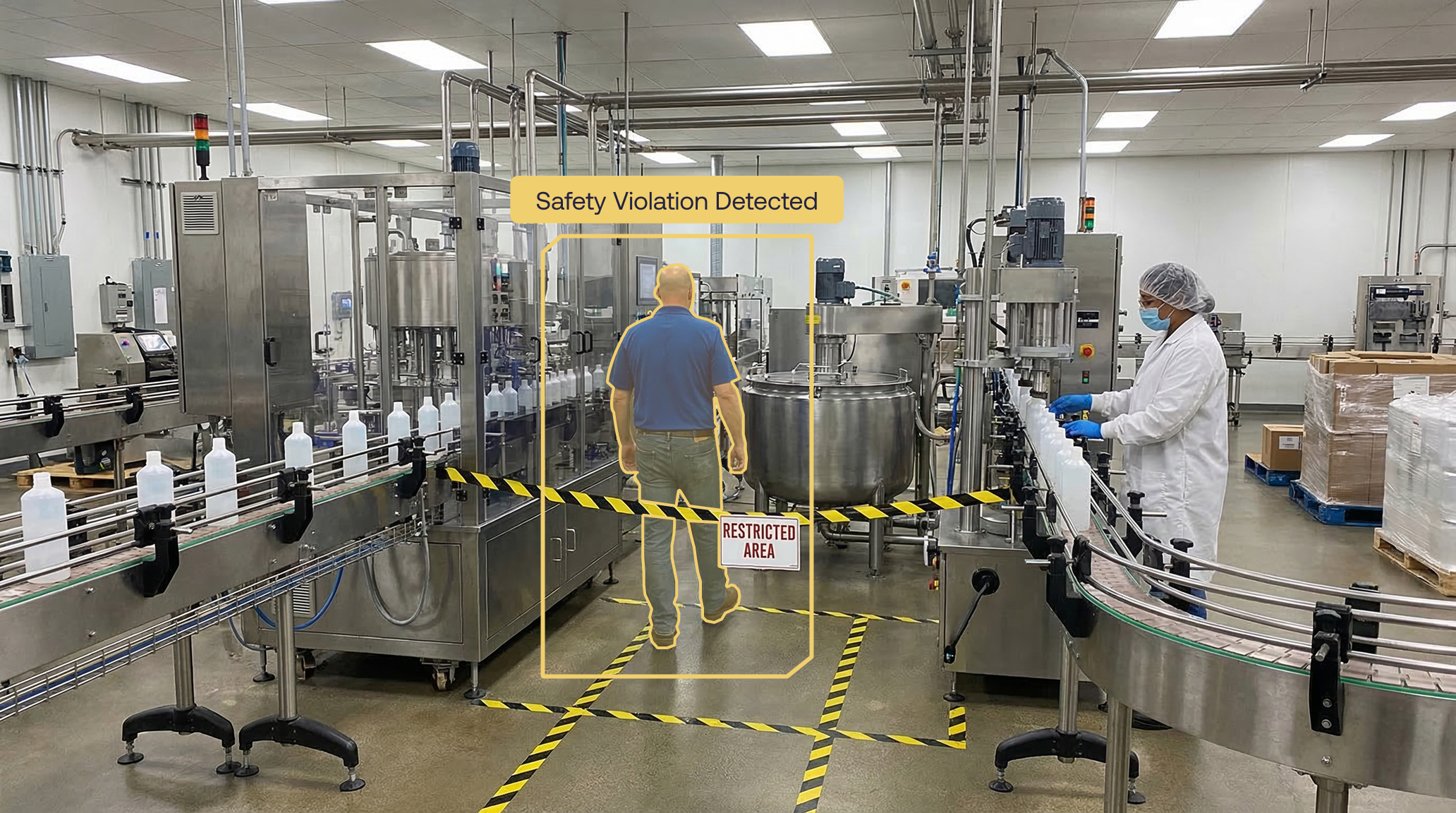
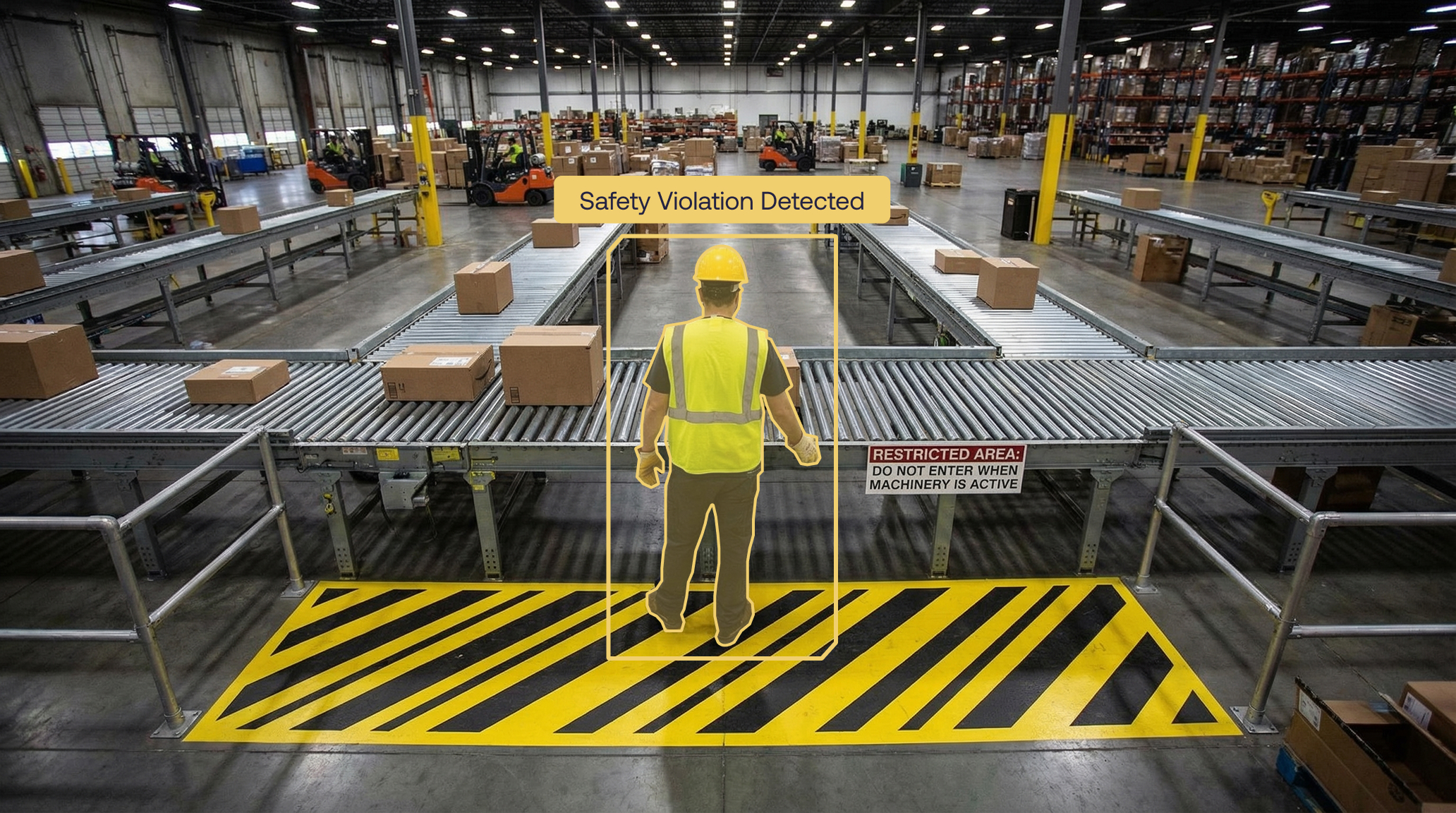
If a worker steps into a restricted zone or approaches an unguarded machine, the AI doesn't just log it for a Friday report. It triggers an immediate action, such as:
- sounding an audible alarm
- flashing a warning light
- stopping the equipment
- sending an instant alert to the floor manager
Warning sign 2: PPE compliance left to the honour system or random audits
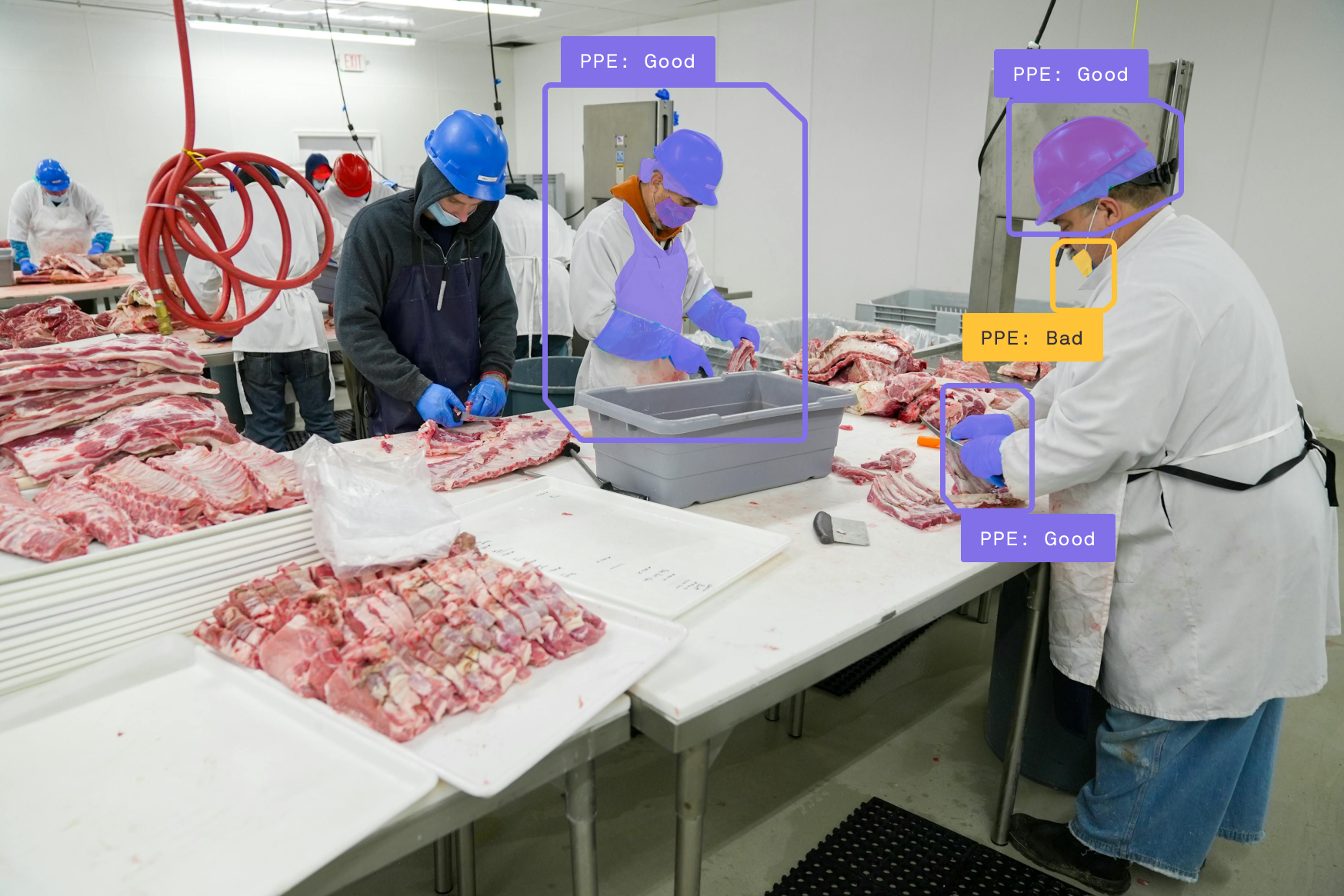
We've all seen it: a worker steps onto the floor without their safety glasses or slips off their high-visibility vest because the bay doors are open and the area is hot. Floor managers do their best to enforce PPE rules, but they cannot be everywhere at once. Random audits catch a fraction of violations, leaving the rest of the shift exposed to massive liability and injury risks.
OSHA's persistent ranking of PPE violations proves that manual enforcement is failing to create a culture of continuous compliance.
The AI Approach: Automated PPE Detection and Interlocking
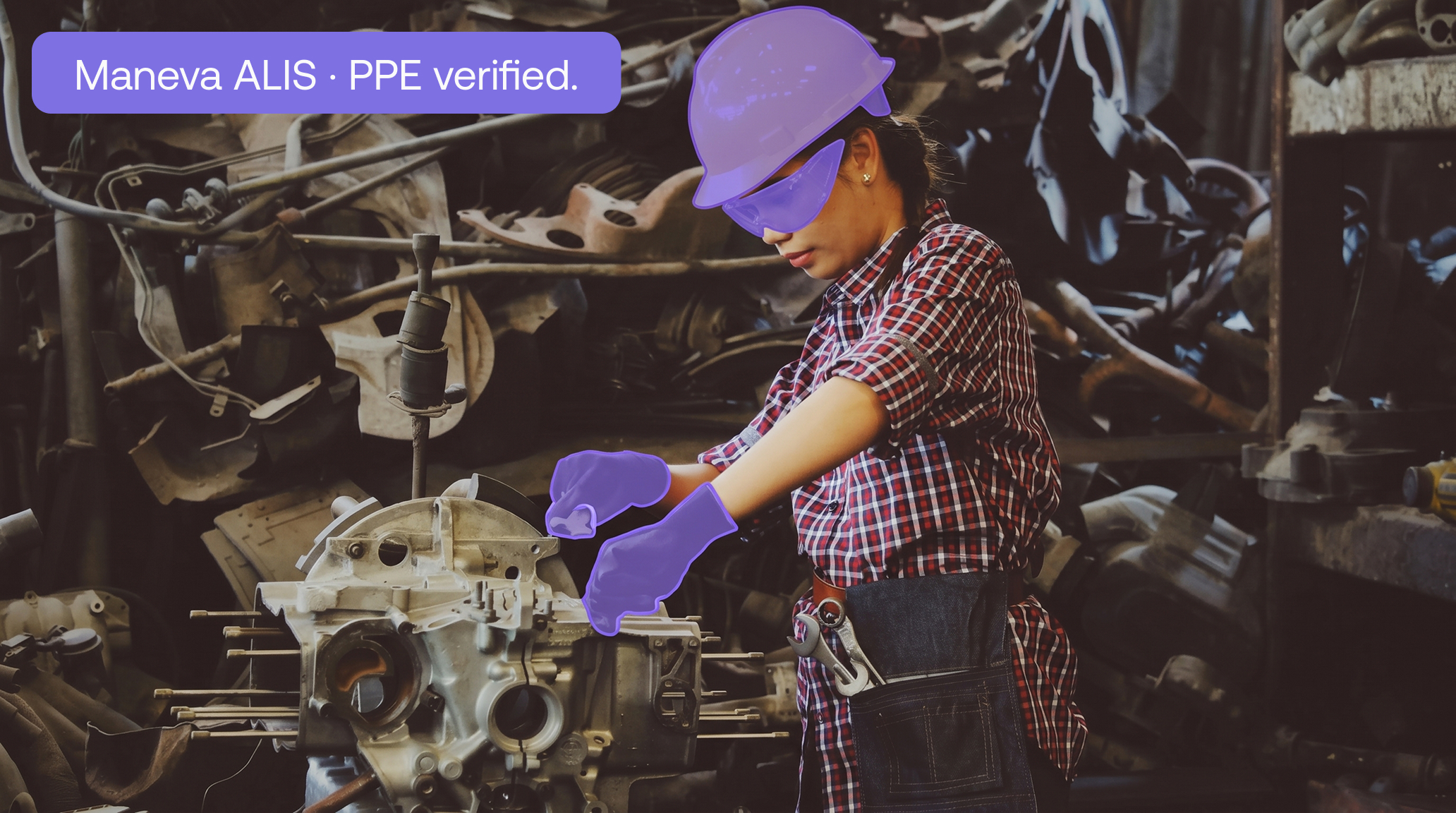
A robust worker safety AI camera system, like Maneva's ALIS agent, continuously scans designated zones for proper PPE adherence.
- High-Visibility and Head Protection: The system instantly detects if a team member enters a forklift operating zone without a hard hat or high-vis vest.
- Specialized Gear: In high-risk zones, the AI can check for specific requirements like safety goggles, respirators, or hearing protection.
- Smart Access Control: Rather than just alerting a manager, the AI can be integrated with your facility's access control doors or turnstiles, refusing to unlock the gate to a hazardous area until the worker is fully equipped with the correct gear.
Warning sign 3: no automated lockout/tagout (LOTO) enforcement
Lockout/tagout violations are among the most lethal infractions on OSHA's annual list. De-energizing machinery during maintenance is a strict, multi-step process, yet shortcuts are taken every day due to production pressures or simple human error.
The terrifying reality of LOTO non-compliance is that you rarely know a rule was broken until a machine unexpectedly recycles or starts up while a technician is still inside the line.
The AI Approach: Visual Verification of LOTO Protocols
AI factory safety monitoring acts as a digital double-check for complex LOTO procedures. Computer vision can be trained to recognize the physical presence of padlocks, tags, and blocks on energy isolation points.
Furthermore, if the AI detects a human body inside the physical perimeter of a machine's danger zone, it can communicate directly with the machine's Programmable Logic Controller (PLC) via an emergency stop (E-stop) override. Even if someone accidentally flips a switch on the other side of the factory, the AI prevents the machine from restarting because it physically sees that the maintenance area is not clear.
Warning sign 4: machine guarding tampering found only after an injury
Machine guarding is designed to be foolproof, but experienced operators occasionally find ways to bypass, cheat, or temporarily remove physical guards to clear jams faster or speed up production cycle times.
Because these bypasses are often done quickly and reassembled before management walks the floor, they represent a massive hidden liability. A machine operating without its guard is a ticking time bomb for an amputation or fatality citation.
The AI Approach: 24/7 Geometric and Spatial Monitoring
AI camera systems don't get distracted, and they don't look away. By setting up virtual "digital fences" around critical machine guards, the AI understands the exact geometric configuration of a safe machine.
If a guard is unbolted, swung open, or cheated with a bypass key while the machine is running, the computer vision model instantly flags the anomaly. The system can immediately cut power to the machine tool, preventing operation in an unsafe state, and logging the event so safety teams can address the root cause of why the operator felt the need to bypass the guard in the first place.
Warning sign 5: forklift and pedestrian safety relying on looking both ways
Forklift strikes remain one of the leading causes of severe workplace trauma in warehousing and manufacturing. Blind corners, noisy environments, and distracted walking mean that painted floor lines and convex mirrors are no longer enough to keep pedestrians safe from multi-ton industrial vehicles.
If your current near-miss reporting relies on workers voluntarily filling out paperwork after a close call with a forklift, your data is vastly underreporting the true risk on your floor. National Safety Council injury data consistently shows that voluntary near-miss reporting captures only a fraction of actual close-call events.
The AI Approach: Proactive Proximity and Behavior Analysis
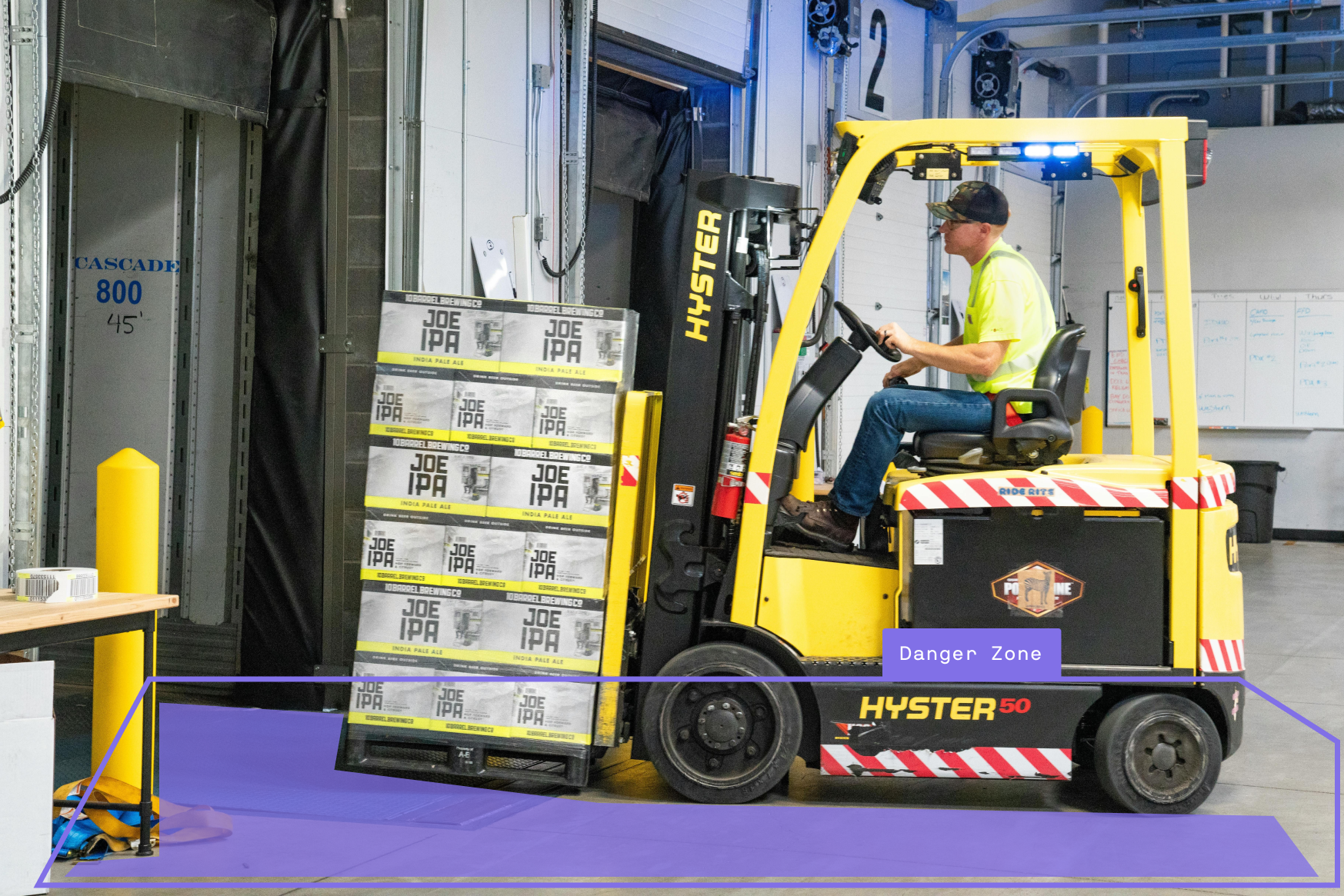
Integrating AI into your overhead camera network allows for dynamic spatial tracking of both foot traffic and industrial vehicles, with real-time safety alerts triggered the moment a collision course develops.
Traditional Camera: Records the accident → Management searches through hours of video → Post-incident review (too late)
AI-Enabled Camera: Detects proximity → Triggers automated horn / E-stop → Saved life
The AI continuously calculates the distance vectors between moving forklifts and walking employees. If a pedestrian steps around a blind corner into the path of an oncoming vehicle, the AI calculates the collision course in milliseconds, instantly triggering flashing intersection lights or slowing down the smart-connected forklift automatically. It turns "near misses" into measurable data points without relying on human reporting.
How does AI safety monitoring turn existing cameras into prevention?
If any of these five warning signs resonate with your current operations, your facility is operating at an elevated risk level. Over my 30 years running plants, I've learned that the transition to a safer floor doesn't require tearing down your entire infrastructure. It requires upgrading the intelligence behind it.
An effective AI factory safety monitoring strategy relies on a Video-to-Action framework. It bridges the gap between seeing a hazard and stopping it. By leveraging a worker safety AI camera system like Maneva's ALIS agent, you empower your leadership with eyes on every square foot of the facility, transforming your safety posture from a defensive, reactive scramble into a proactive, life-saving shield.
Don't wait for an OSHA or WSIB auditor, or a tragic incident report, to reveal your factory's AI safety blind spots.
Ready to see how Video-to-Action AI can protect your team and secure your operations? Book a demo at maneva.ai for a custom floor assessment.