
How Can Food Packers Catch Seal Failures Before Shipping?
The gap between detection and prevention
In February 2025, the FDA recalled canned tuna from Tri-Union Seafoods after a lid defect could compromise the seal, risking leaks or botulism. The issue was not manufacturing intent. It was a seal defect that passed through inspection and reached consumers. Your quality program catches defects, but it catches them after they have already left your plant.
By the time your weekly QA report surfaces a defect spike, hundreds or thousands of packages with marginal seals are already in distribution, sitting in warehouses, on retail shelves, in customers' hands. This is the operational reality most quality leaders face: statistical sampling gives you a rearview mirror, not a windshield. Here is the question that keeps quality leaders up at night: what defects are you missing between samples?
Why do marginal seals slip through inspection?
Because inspection today samples. In food packaging, seal integrity is the control point that matters most, yet a marginal seal does not look bad to the eye and does not trip an alarm at shift end. It just ships. Even aggressive sampling, 5% or 10%, means defects are produced for hours, sometimes days, before anyone knows.
For a VP of Quality or Operations, that is not just a quality miss. It is a scrap rate you cannot quantify, a yield loss invisible in your reports, and a complaint risk you cannot prevent. What changes the picture is real-time seal defect detection paired with root cause clarity that operators can act on immediately.
What does real-time detection change on the line?
It moves the catch from the warehouse back to the moment the defect is made. About a year ago, I worked with a mid-scale food packer running a high-speed sealing line producing thousands of packages per hour. Their seal defect rate had spiked to over 60% during a production cycle. Under end-of-shift sampling and weekly trend reports, they would have discovered this after tens of thousands of defective packages were already in the system. Instead, they deployed Maneva's VITA vision inspection agent connected to our Maneva Orchestration Platform.
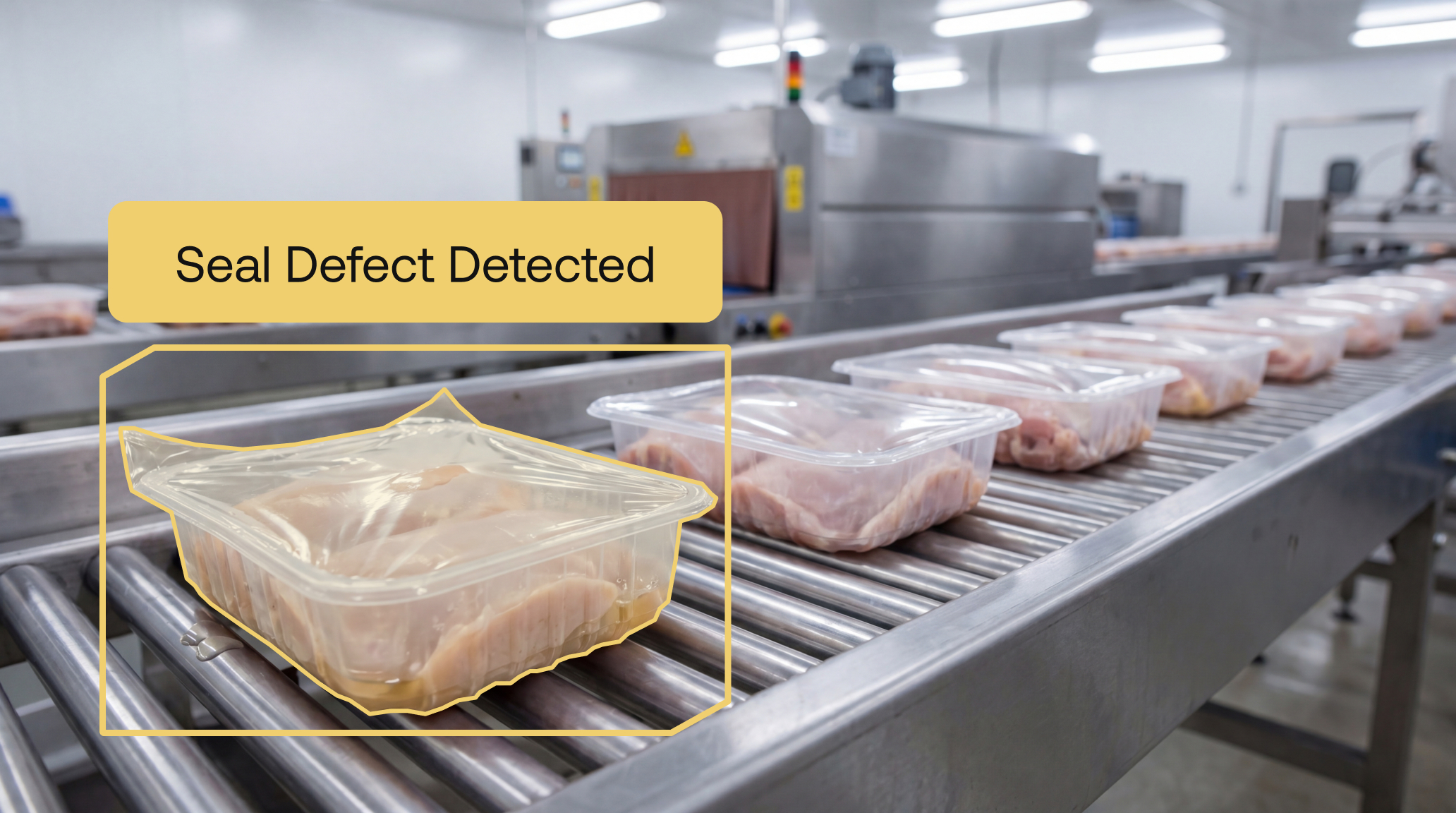
Every package ran through VITA, our real-time visual inspection agent. The cameras identified defects in milliseconds, incomplete seals, contamination on the film, thickness variability, deformation, and classified each one instantly. But the insight did not stop there. The defect data fed directly into the Orchestration Platform, which surfaces root cause in real time. Within five minutes, the system identified the likely cause: temperature drift on chamber two, pressure variance at pockets 3-5, contamination on the incoming film, material batch inconsistency.
That insight went directly to the people who could act, the operator at the line, maintenance, and quality. Not a report filed for later review. The operator could adjust sealer temperature. Maintenance could inspect a blade. The line could slow to clear contamination. A material lot could be changed. All while defects were being produced, not hours later. Because the process was corrected in real time, they did not just catch bad packages, they prevented the conditions that produce them. Within weeks, the defect rate dropped from over 60% to under 5%.
The velocity of that improvement matters. Statistical sampling might have surfaced the trend after two weeks of data collection. Real-time detection with the Orchestration Platform let this packer see, diagnose, and correct the problem within days. That is not incremental improvement. That is operational transformation.
What actually changed for this packer
When this customer first contacted us, their question was simple: how do we know what is really leaving our facility? We answered it with vision-based detection at scale. VITA inspects every package, no sampling estimates and no statistical lag, and every defect gets logged. But detection alone does not solve the business problem. A defect report that arrives three days later is still too late. The Orchestration Platform connects visual defect data to process conditions, temperature readings, pressure sensors, material batches, line speed, and surfaces the correlation to the right person in real time. An operator who knows "this defect is caused by temperature drift" can correct it. One who only knows "we have defects" is guessing. Over the months this customer ran with VITA and Orchestration, four things moved:
- Defect rate became measurable: Their defect rate moved from impossible to measure with sampling to precise and manageable, every defect counted. That clarity let them set realistic targets and track progress weekly instead of monthly.
- Scrap became preventable: Every defect caught before shipping meant scrap prevented: no rework decisions downstream, no retailer returns, no line stops for late-discovered quality issues. An 80% reduction in scrap across the affected line.
- Yield stopped being a mystery: When defects are caught at the moment they happen, yield is not compromised by discoveries at the warehouse or retail level. It is protected by prevention.
- Seal-failure complaints stopped: Marginal seals that would have generated consumer or retailer complaints never left the plant.
Why did the operators stop guessing?
Because they could finally see the cause, not just the symptom. Something happened that I did not expect when this customer first deployed the system: the operators, maintenance, and quality teams changed. Once they could see defect data tied to root cause, "temperature too high," "film contamination," "pressure variance," they stopped waiting for QA feedback from hourly checks. Action was taken within five minutes.
That shift in ownership is measurable in how fast defects trended down. The operator became part of continuous improvement, not a passive executor of process specs. The maintenance team knew exactly what to prioritize, not "seal quality is drifting somewhere" but "chamber two thermocouple is reading high, causing weak seals on pockets 3-5." That specificity changed how they worked.
What this means for your operation
If you are a quality leader thinking about this, real-time detection is not about one more data point. It is about closing the gap between when a defect occurs and when you can prevent the next one. The practical questions are straightforward. Do you know your true defect rate, or just a statistical estimate? How long does it take to surface a defect trend today, days or weeks? What is the cost of a seal-related complaint or retailer pushback? What would a 50-80% reduction in defect rate mean for your scrap, yield, and complaint metrics?
Seal defects do not have to be a risk you manage after the fact. They can be a process you prevent in real time. That is what Maneva's VITA agent and the Orchestration Platform are built to do: detect defects visually at scale, surface root cause immediately, and get the insight to operators while they can still act. It is the same real-time inspection approach we described in plug-and-play AI quality inspection, here aimed at the seal. Book a demo, or learn more about Maneva for food and beverage.