

How Do Electronics Plants Catch Assembly Errors Before Final Test?
Electronics plants catch assembly errors before final test by inspecting the work at the assembly station, while it happens. Training, visual SOPs and poka-yoke reduce errors but cannot detect them, and functional test only finds them at the end of the line, where each fix costs roughly ten times more. In-process electronics assembly inspection closes that gap.
Every electronics plant fights the same battle: stopping a small mistake at an assembly station from becoming an expensive failure further down the line. The stakes are high. The American Society for Quality (ASQ) has long estimated that quality-related costs can run as high as 15-20% of sales revenue, and much of that money disappears into scrap, rework and re-inspection that never appear as one clear line in the budget.
How do electronics plants prevent assembly errors today?
Most use a layered defense. Each layer has real value, but, as we will see, they all share the same blind spot.
Layer 1: Operator training
Well-trained operators make fewer mistakes. Industry certification programs, such as the IPC assembly standards, exist because skills and knowledge reduce both early failures and field failures. But training sets a baseline. It cannot guarantee every action, on every unit, on every shift.
Layer 2: SOPs with pictures
Standard operating procedures with clear images turn individual know-how into a repeatable method. Annotated photos at each step help operators, especially on long assembly sequences. Still, an SOP can be misread, skipped under time pressure, or followed with the wrong part in hand.
Layer 3: Poka-yoke error-proofing
Error-proofing (poka-yoke) designs the workstation so that only the correct parts are available: kitted trays, keyed fixtures, pick-to-light bins. It is one of the most effective prevention tools in lean manufacturing.
Why don't training, SOPs and poka-yoke catch every assembly error?
All three layers aim to stop the error from being made in the first place. They are essential, but none of them actually blocks an error once it happens. The operator is still free to misinterpret an instruction, pick up the wrong part, or place the right part in the wrong location or orientation. Polarized components such as diodes, electrolytic capacitors and ICs are a classic trap: the right part, mounted the wrong way round.
The opportunities for error add up fast. A typical board with around 1,000 components carries nearly 6,500 defect opportunities. Test-strategy research presented at IPC APEX found that boards built in higher volumes on the same SMT line typically run at 200 to 600 defects per million opportunities (DPMO). Do the math on a modest assembly with just 1,000 opportunities at 200 DPMO, and nearly one unit in five will carry at least one defect.
Asking humans to check humans does not close the gap. An estimated 80% or more of visual inspection is still done by people, and one study put human inspectors at only 70-80% effectiveness. Their performance also slips as fatigue sets in over a long shift.
What does it cost to catch assembly errors at functional test?
That leaves the end-of-line functional test as the real safety net. Building a test bench that powers up a circuit and checks that it behaves correctly is relatively simple, and it is a powerful check.
Its weakness is its position: it sits at the very end of the process. By the time a defect is found, every downstream operation has already been spent on a bad unit. The only options are to scrap the product or send it through rework, which is slow, labor-intensive and can itself damage the board.
This is where the "rule of ten" applies. Preventing a defect is the cheapest option. Catching and correcting it internally costs roughly ten times more. Once it reaches the customer, the cost can rise to roughly a hundred times more, which is how the hidden cost of poor quality builds up.
In PCB assembly the multiplier repeats at each stage: one SMT industry analysis notes that in-line repair finds only about 90% of defects, and the remaining 10% are found later, at ten times the cost per stage.
Functional test also has a coverage problem. It tells you that something is wrong, not what or where. A board can pass with a marginal solder joint that fails months later in the field. The same IPC APEX paper notes that no test or inspection system is 100% effective, which is why plants combine methods such as AOI, X-ray and in-circuit test at different points in the process.
How does Maneva inspect electronics assembly as it happens?
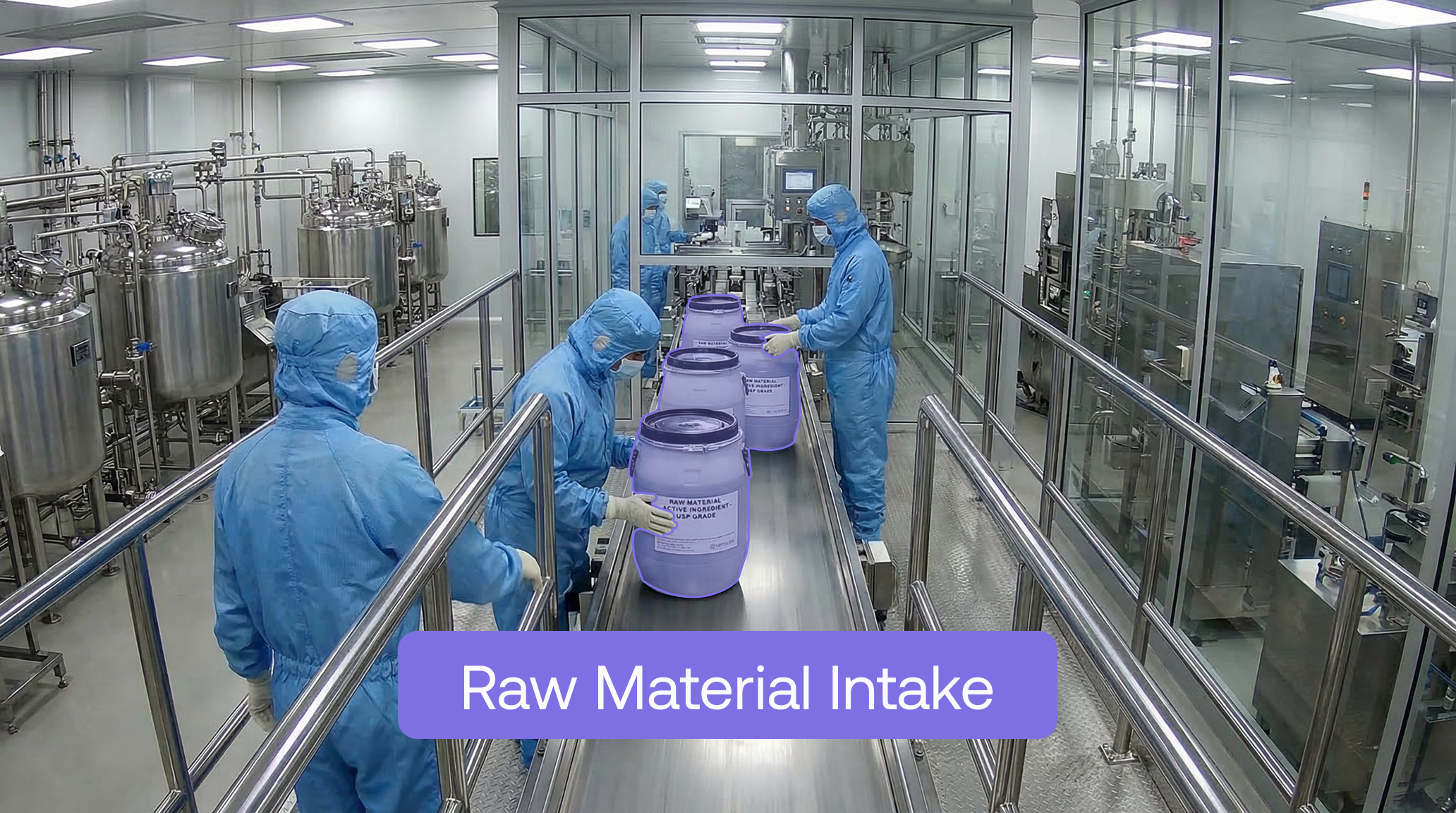
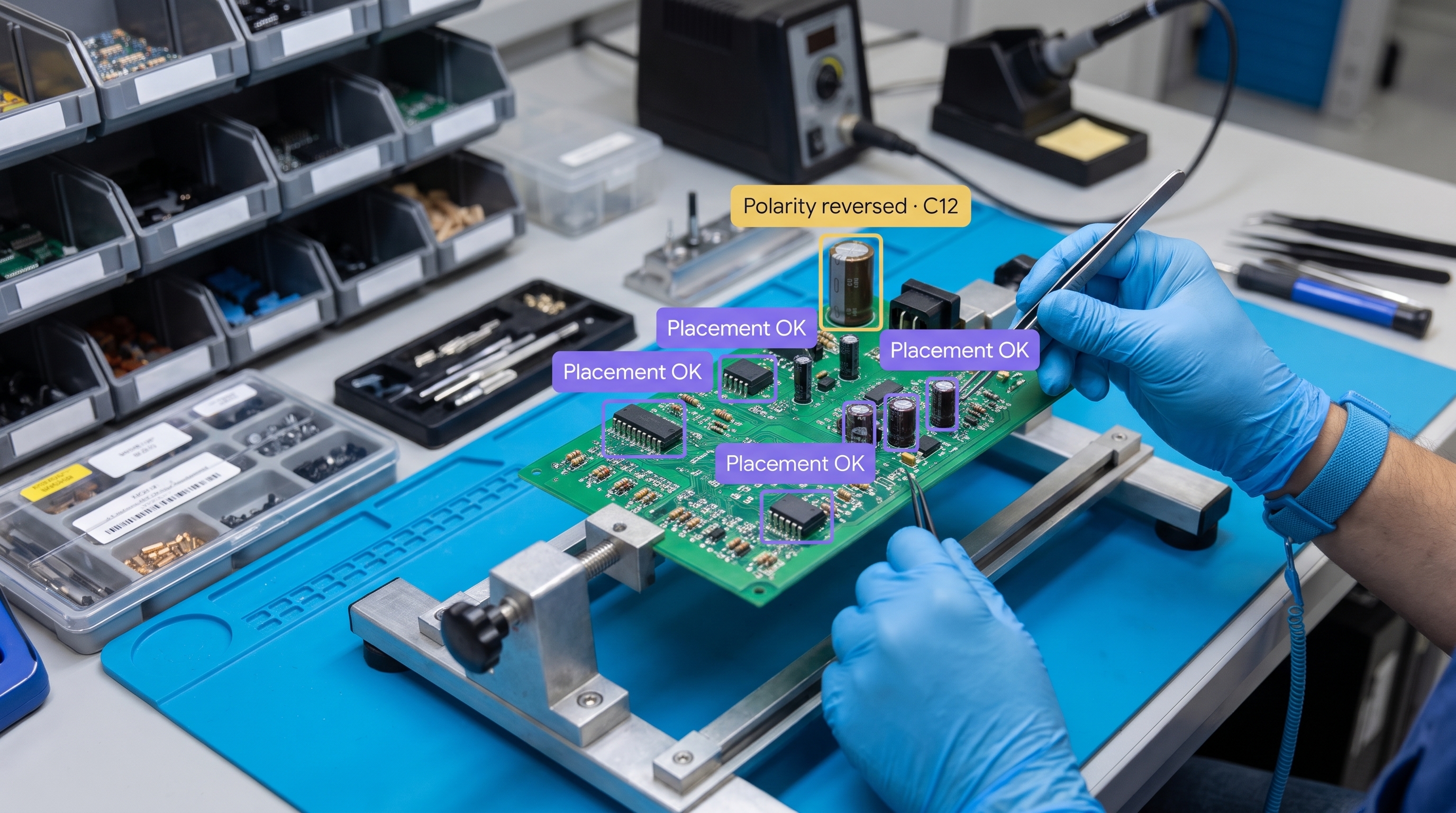
Maneva moves detection to the place where errors are made. With Video-to-Action AI, a camera at the assembly station checks the work as it happens. ALIS, Maneva's AI Line Supervisor, follows the operator's assembly steps, and VITA, Maneva's Video-to-Action AI agent, checks the board itself. Together they verify:
- Assembly sequence: parts are assembled in the correct order, so that nothing gets hidden under a step that cannot be undone.
- Right part, right place, right orientation: the correct component sits at the correct position, with the correct polarity.
- Soldering quality: joints are checked for defects such as insufficient solder, bridges or cold joints.
This is 100% inspection, not sampling. When the camera detects a non-conformity, the unit is stopped and cannot move forward. The operator corrects the error on the spot, at the cheapest point on the cost curve.
What changes on the production floor
- Lower cost per defect. Errors are fixed at the station, at "1×" cost, instead of "10×" at final test or "100×" in the field.
- Less scrap and rework. Fewer units reach the end of the line with assembly errors, so fewer go to the scrap bin or the rework bench.
- A leaner final test. With assembly errors filtered out upstream, the functional test can focus on what it does best: catching defective components.
- Consistent quality on every shift. A camera does not get tired at the end of a long shift, so detection does not drift with fatigue.
- Data for continuous improvement. Inspection results become data. Recurring errors point directly to the SOP, the station or the part that needs attention.
Closing the gap between prevention and final test
Training, visual SOPs and poka-yoke remain the foundation of quality in any electronics plant. But they prevent errors; they do not detect them. Functional test detects errors, but too late and at the highest internal cost. In-process vision inspection closes the gap between the two: it catches assembly errors at the moment they happen, when fixing them costs the least.
The result is a production line where the final functional test confirms quality instead of rescuing it. And because every caught error becomes data, the line learns where to fix the process itself, which is where a self-improving factory starts.
See how Maneva supports quality assurance on electronics lines →