

How Do Meat Plants Catch Foreign Objects Before Packing?
When you spend 35 years managing further processed protein plants, running everything from high-speed bacon lines and fully cooked chicken nugget systems to emulsified sausage operations, you learn one fundamental truth early on: no single piece of technology is a silver bullet for foreign material detection.
If anyone tells you there is one magical machine that will catch every piece of foreign material contamination in food before it hits a carton, as of today, it doesn't exist, and they've never stood on a wet sanitation floor at 2:00 AM troubleshooting a line shutdown.
According to USDA FSIS recall data published by Food Safety Magazine, foreign material contamination was the leading cause of meat and poultry recalls in 2025, accounting for 13 of 42 recalls, nearly 31 percent. That is a critical statistic for anyone who bears the ultimate operational responsibility for plant output, brand integrity, and public safety.
So, how do modern meat plants actually prevent foreign material from reaching consumers? The answer isn't finding one perfect machine; it's building a deliberate, multi-layered defense strategy. In meat processing, foreign object detection works best in layers: magnets, metal detectors and X-ray for what is inside the product, and AI vision for what sits on its surface.
How has foreign material detection in meat plants evolved?
When I started in this industry over three decades ago, line inspection was almost purely visual and manual. We relied on hawk-eyed quality assurance technicians and line operators staring at high-speed conveyors for hours. But human fatigue is real. Eye strain sets in, micro-distractions happen, and speed inevitably wins over human capabilities. Manual inspection alone simply wasn't enough.
As processing speeds increased, our line of defense evolved:
- Rare earth magnets: We installed high-intensity inline magnetic traps to catch fine ferrous metal shavings shedding off grinders, blenders, and pumps before product ever reached the cookers.
- Industrial metal detectors: We added metal detection systems downstream to catch larger non-ferrous and stainless-steel fragments that magnets missed.
- Advanced X-ray systems: As dense bone fragments and glass became major quality concerns, X-ray inspection entered the plant. X-rays allowed us to look inside dense product matrices to find embedded hazards like calcified bone, glass, or heavy metals.
Each technology solved a specific problem that the previous one couldn't. Yet, even with magnets, metal detectors, and X-ray systems running in series, foreign material recalls kept making headlines across the meat industry.
Why? Because our equipment was evolving, but so were our processing environments.
Hidden gaps: why X-ray and metal detectors aren't enough
Metal detectors only find metal, and X-ray only finds material that differs clearly in density from the product around it. Plastics, rubber, film and other low-density materials can pass through both, which is why foreign material recalls continue in plants running all three systems.
To understand why traditional detection leaves gaps, you have to look at modern equipment setup and wear points.
- Metal detectors are exceptional at finding metal, but they are blind to non-metallic contaminants like hard plastics, rubber gaskets, or wood.
- X-ray systems excel at identifying dense hazards (metal, stone, bone, thick glass) by measuring density differentials. However, thin plastics, flexible guardrail materials, colored poly plastics, vinyl gloves, or low-density conveyor belt shavings match the density of meat so closely that X-rays pass right through them without triggering a reject signal.
Think about the daily wear and tear inside a further processing facility:
- Plastic guide rails on spiral freezers chipping under thermal shock.
- Modular plastic conveyor belts wearing down and shedding micro-fragments into hot, cooked product.
- Wear plates, conveyor belts and edge guards, or plastic scrapers degrading over time.
- O-rings or gasket material tearing loose during aggressive mechanical mixing.
- Small mechanical fasteners or machine components loosening above open cookers, ovens, or fryers.
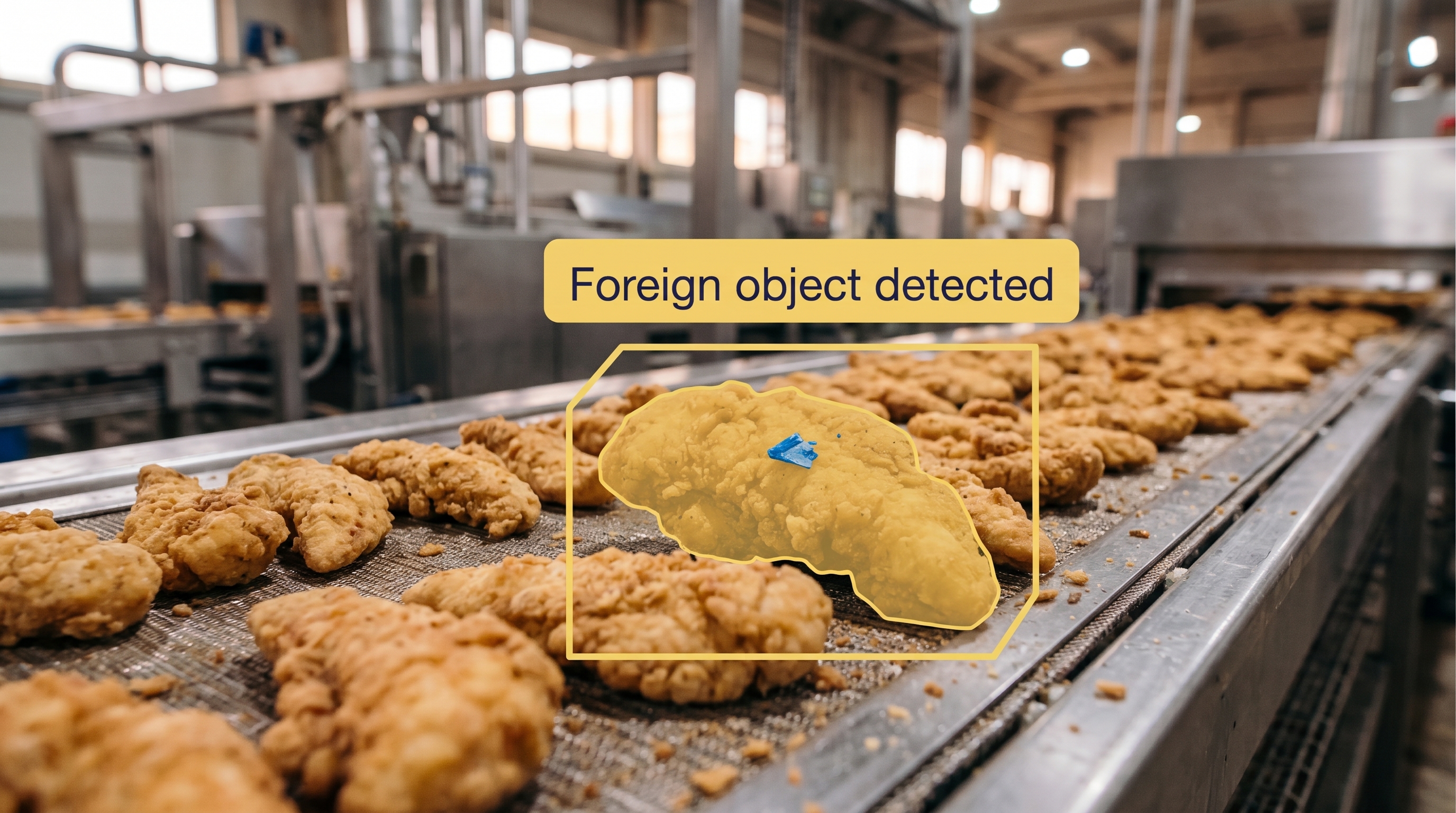
If a blue plastic scraper blade chips off into a bed of cooked chicken tenders, a metal detector won't chime. An X-ray machine won't flag it. The product moves straight to the primary packaging station, unless you have an inspection layer designed specifically to spot surface anomalies.
Many plants have moved to metal-detectable or X-ray-detectable plastics for scrapers, gloves and hand tools. That helps, but not every plastic part on a line can be swapped, and a detectable fragment still has to be large enough to trigger the reject.
How does AI vision catch foreign objects on the product surface?
This is where advanced AI vision technology fills a critical void in meat processing foreign object detection.
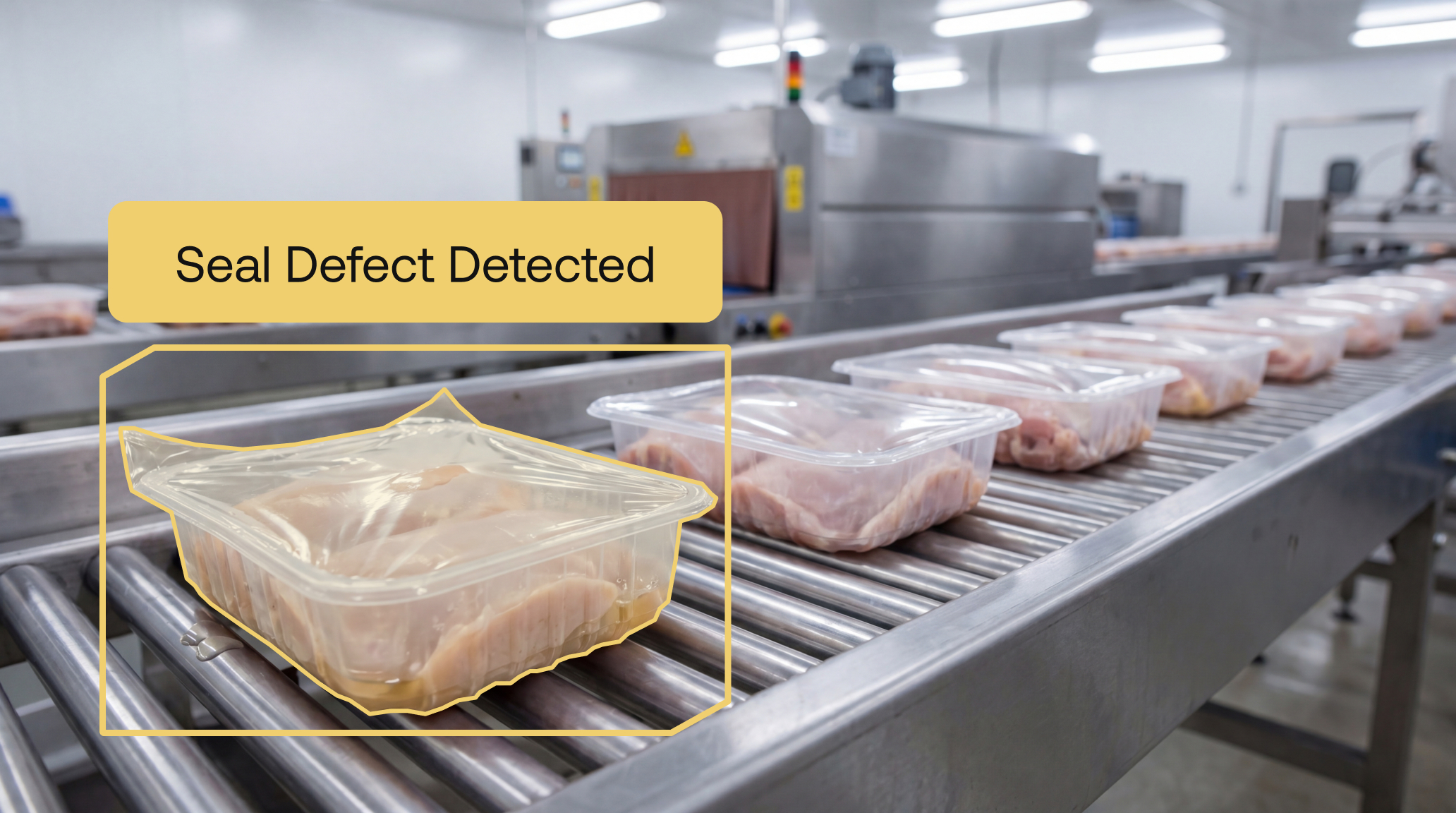
AI vision doesn't replace metal detectors or X-rays; it works alongside them as a specialized layer of surface inspection. Where X-rays look through the product to find hidden dense materials, AI vision continuously inspects the surface of every piece of product in real time.
Modern AI-driven vision systems use sophisticated deep-learning models trained on tens of thousands of real-world plant images. Unlike legacy optical sorting systems that struggled with variations in product shape, color, or lighting, AI vision understands what normal product looks like versus what doesn't.
At Maneva, this layer is VITA, our quality and downtime agent, running Video-to-Action AI. It sees every piece that passes the camera, decides whether anything on the surface doesn't belong, and acts: it triggers the line's reject device so the piece never reaches the carton, and logs each rejection with its image. Over time, that log shows QA which guide rail, belt or scraper keeps shedding fragments, so the source gets fixed, not just the product.
Real-world scenarios where AI vision excels:
- Plastic chipping and belt degradation: When modular plastic conveyor tiles or polyethylene guardrails chip, AI vision instantly recognizes the non-conforming texture, shape, or color anomaly on the product surface and triggers a high-speed rejection mechanism.
- Poly bags: We all know the pain of poly bags, commonly used throughout the industry to cover and store or transport raw material and products, and the pieces that tear off and find their way into the process. A vigilant set of eyes now looks at and inspects material as it makes its way through the production line.
- Equipment component failures: If a rubber gasket, nozzle component, machine guard or washer detaches from upstream equipment and drops into the cooking process, the vision system catches it before it is battered, breaded, cooked or packed.
- Surface bone and cartilage: While deep-embedded bone requires X-ray, surface bone or cartilage fragments on raw cutlets or trim are readily identified by high-resolution visual cameras.
- Over-cook, under-cook and quality defect sorting: As an operational bonus, the same vision models guarding against foreign material can simultaneously verify cook color, missing breading, or size specifications, improving overall product quality in food and beverage packaging applications.
What can each inspection technology miss?
As someone who spent 35 years managing operations, I have zero tolerance for tech vendors who promise the impossible. It is vital for plant managers, sanitation directors, and QA leads to understand the boundaries of every tool in their HACCP plan:
- Cameras can only see what is visible on the surface. If a wire fragment is deeply embedded inside a 4-ounce beef patty, AI vision will not catch it. That's what your metal detector or X-ray unit is calibrated for.
- Conversely, if a piece of yellow plastic guardrail breaks off and lies on top of that same patty, your metal detector and X-ray will miss it, but AI vision will flag and reject it in milliseconds.
How do you build a layered foreign material inspection plan?
Preventing foreign material contamination in food isn't about choosing between X-ray, metal detection, or AI vision. It's about designing an integrated, multi-layered inspection strategy where each technology covers the blind spots of the others.
By combining:
- Upstream magnetic separation at raw receiving and blending,
- In-line AI vision at key transfer points, post-cooking, and before packaging, and
- End-of-line X-ray or metal detection immediately before final packing,
you create an overlapping defense grid that protects your customers, supports your USDA FSIS compliance, keeps product safe and preserves the brand equity you've worked decades to build.
In 35 years of plant management, I've seen processing lines double in speed and output. The risks of contamination haven't disappeared, but with AI vision now backing up our traditional detection equipment, we finally have the tools to catch what commonly slipped through the cracks.
See how a surface inspection layer works on your line: AI quality assurance with Maneva.