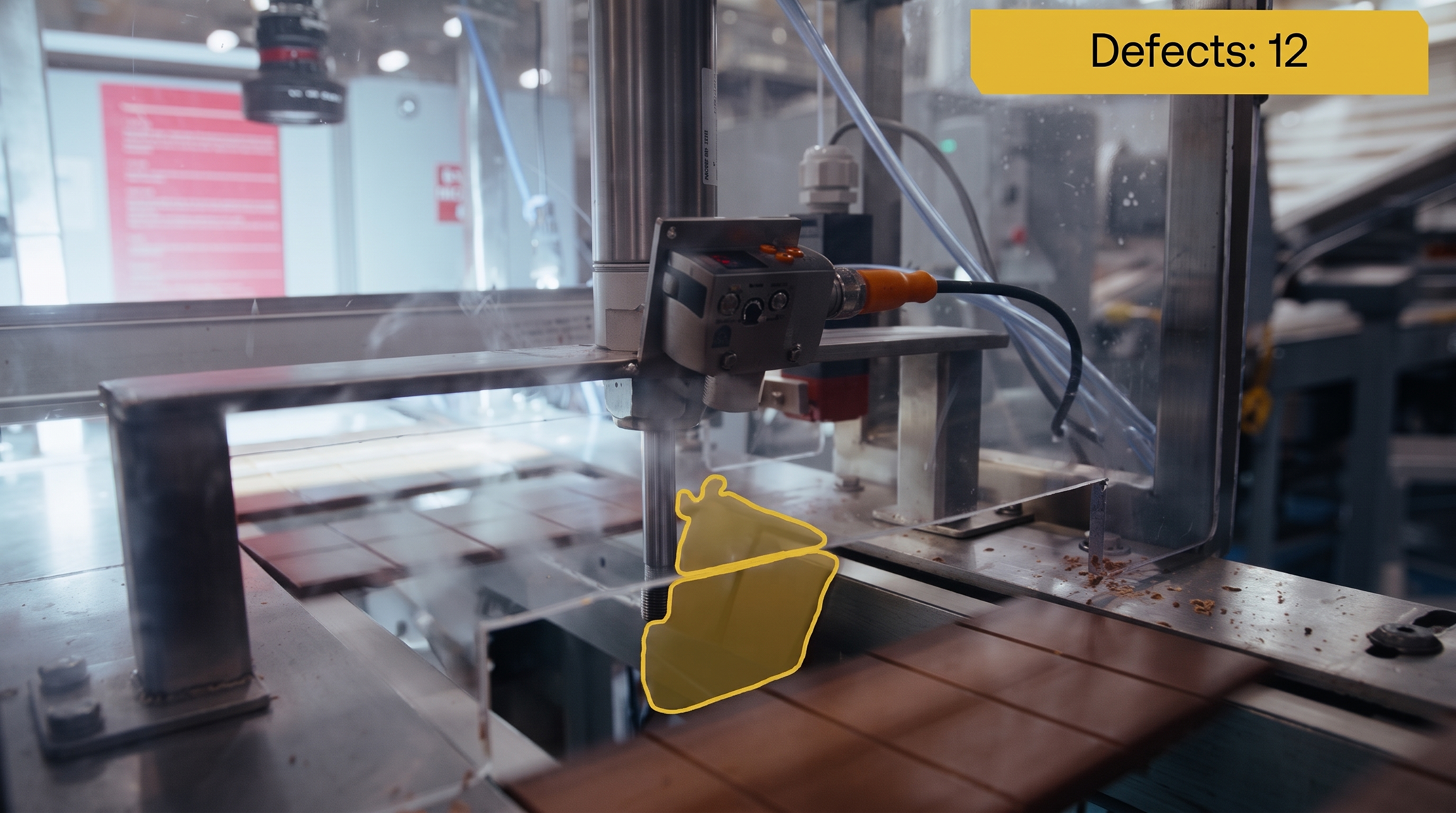
Reject pusher removing a defective chocolate bar from the line, outlined in yellow with a Defects: 12 counter
Use cases

How do confectionery lines remove defective products without stopping?

Video-to-Action AI decides on each unit as it passes the camera and sends the reject signal to a pusher, air jet or robotic arm, so defective products leave the line without anyone stopping it. Every rejection is logged with its image, so the quality team can see what was removed and why.

Confectionery
Quality Assurance

What it decides

For every unit that passes the camera, Video-to-Action AI makes one of three calls and acts on it at line speed:

  • Accept: the unit continues to wrapping
  • Reject: broken, misshapen or contaminated units are removed by the line's reject device, such as a pusher, air jet, diverter or robotic arm
  • Reroute: units with cosmetic flaws, such as surface scratches or discoloration, go to rework instead of scrap, where your process allows it

For the defects themselves on a chocolate line, see chocolate bar defect detection.

Why manual rejection falls behind

At full line speed, people can only pull what they happen to notice. Defects that pass between checks reach packaging, and stopping the line to remove one bad unit costs more output than the unit is worth. In our candy customer story, manual inspection could not keep pace with high-speed production, which left a real risk of defects reaching consumers.

How it acts

VITA, Maneva's quality and downtime agent, makes an accept, reject or reroute decision on every unit in real time, up to 30 quality decisions per second. When a unit fails, VITA sends the signal to the line's reject mechanism, which removes it into a reject bin or lane while the line keeps running.

Each rejection is logged with the image that triggered it. A live defect count shows when rejects start to climb, so the team can check the molds, depositor or conveyor upstream before the problem grows.

Where it sits on the line

The camera watches product from above, ahead of the reject point and before wrapping, so a defective unit is removed before it is packed. In the candy deployment, the system was connected to a robotic arm and rejection mechanism on a high-speed inspection line. Some lines can start with cameras they already have; many need at least one off-the-shelf camera placed for the task. Maneva helps choose the camera and where it goes.

Result

A Canadian candy manufacturer automated defect detection and rejection at line speed: defective items were removed before packaging and throughput stayed high. Read the customer story.

See it on a line like yours →

More for confectionery plants: AI for confectionery lines →

Frequently Asked Questions

Frequently Asked Questions

Didn't find what you need? Our team will walk you through Video-to-Action AI and show how it fits your production environment.
The line's reject mechanism removes it into a reject bin or lane, and the decision is logged with its image, so the quality team can review what was removed and why.
Video-to-Action AI sends the reject signal to the line's mechanism, such as a pusher, air jet or robotic arm. In our candy deployment it was connected to a robotic arm. The integration is scoped with your team for each line.

It depends on your site and the problem you want to solve. Some customers can start with the cameras they already have. Many need at least one new off-the-shelf camera placed and set up for the task, so the AI sees exactly what it needs to see.

Maneva helps you scope this from the start. We look at your line, the result you want, and what the camera needs to capture, then recommend the right camera and where to put it.

Maneva is hardware agnostic and connects to a wide range of camera types, including:

  • Standard RGB and security cameras for many quality, downtime, safety and efficiency use cases
  • 3D and depth cameras for measuring volume, position and dimensions
  • Thermal and infrared cameras for heat signatures and low-light areas
  • Short-wavelength infrared (SWIR) cameras, which see through plastic to check seal integrity
  • High-resolution precision cameras for defects under a millimeter across large surfaces

If you can see it in the video, our AI can understand it and act on it. Start with one line, and we'll help you choose the setup that gets you there.

Related Resources

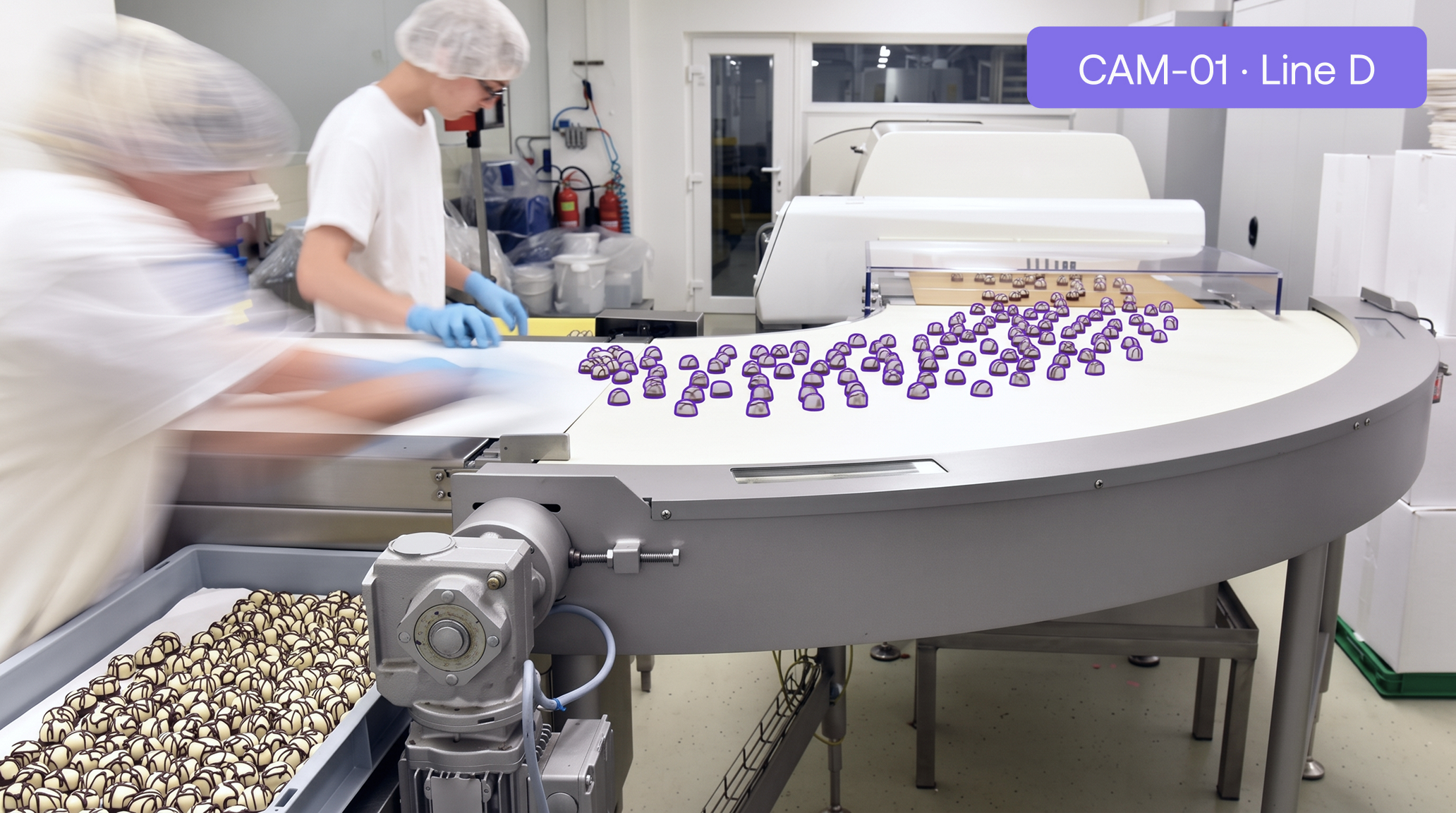
Candy pieces on a rotating conveyor table, highlighted in purple by AI inspection on camera CAM-01, Line D, as workers in hairnets sort product
How a Candy Manufacturer Automated Defect Rejection at Line Speed
Book A Demo
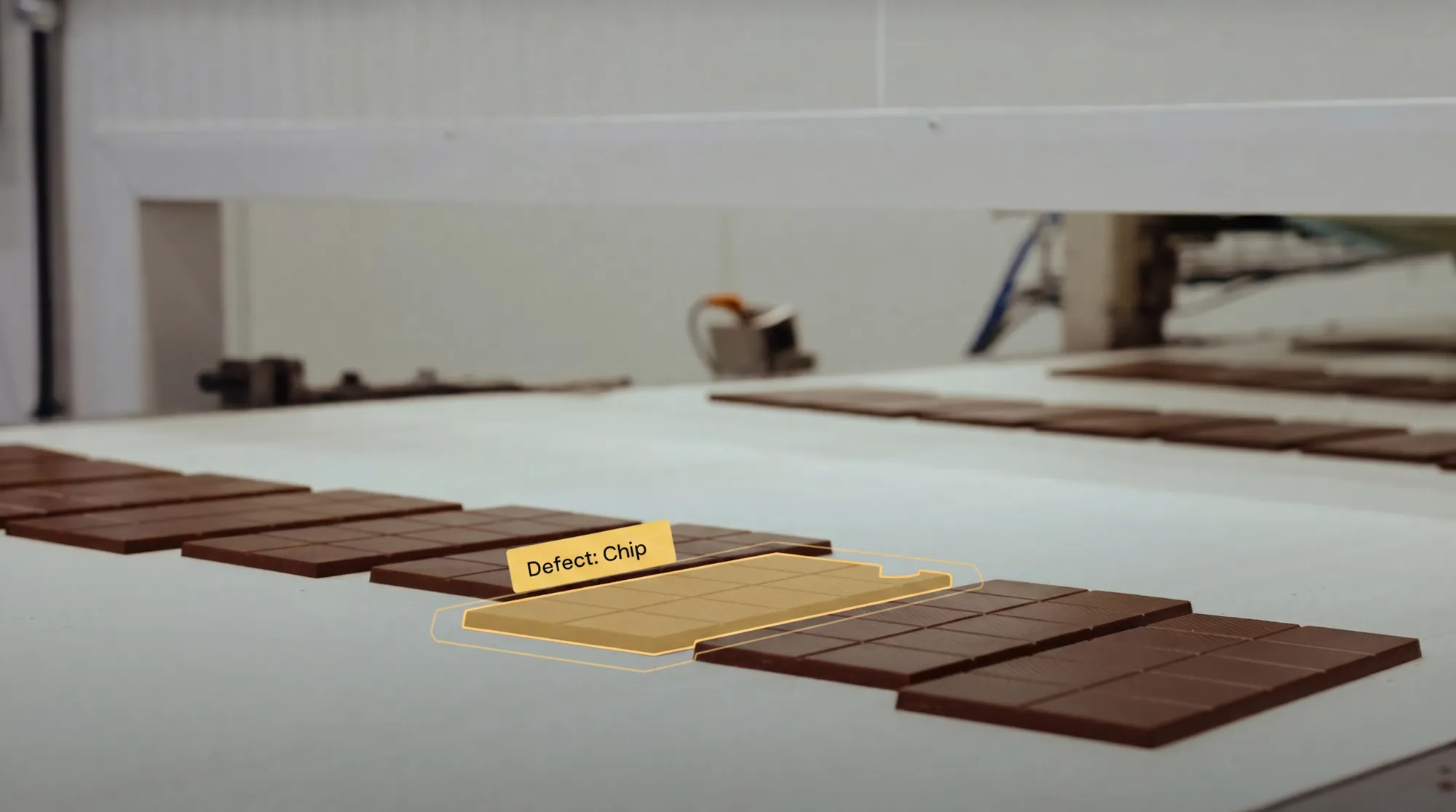
Chocolate bars on a production conveyor, with one bar highlighted in yellow by AI inspection and labeled Defect: Chip where a corner is missing
How a Chocolate Manufacturer Automated Product Inspection
Book A Demo
Maneva VITA AI system performing real-time defect detection on a food and beverage conveyor belt production line
Real-Time Defect Detection: What AI Sees That Humans Miss
Book A Demo

Book a Demo