
How Computer Vision Is Reducing Workplace Incidents in Manufacturing, and What It Takes to Get There
Ask anyone who has spent time on a factory floor and they can tell you about the incident that stayed with them. Not the statistic, the moment. The line going quiet. The supervisor walking faster than usual. The phone call someone had to make to a family that evening.
In 2024, 5,070 people in the U.S. went to work and didn't come home, about 14 every day. Millions more were injured seriously enough to need medical care. And here's the part that should bother every operations leader: almost all of those incidents happened at facilities that had a safety program. Training was current. PPE was stocked. The audit binder was thick and up to date.
So the honest question isn't whether we care about safety. Manufacturing demonstrably does, the rate of serious workplace accidents has fallen roughly 40% over the past 25 years. The question is why, after all that progress, U.S. employers still spend more than $1 billion every week on disabling injuries, and why the curve has stopped bending. I think the answer is uncomfortable but simple: we ran out of what we can see.
It's Not a Safety Problem. It's a Visibility Problem.
Here's the reality of how safety observation works in most plants today. A walkthrough happens once a shift, maybe once a day. A behavior-based safety program logs a few dozen observations a week. Meanwhile, a single production line runs close to 8,700 hours a year. Do the math on that coverage and it lands somewhere below 1%. Everything else, the 2 a.m. hours, the weekend shifts, the moments right after the safety manager rounds the corner, happens unobserved.
And the injuries that keep happening are exactly the ones that hide in that unobserved time. Look at where the money goes: same-level falls cost U.S. employers around $10.5 billion a year, per the National Safety Council, and nearly every one starts with something visible, a spill sitting on the floor for twenty minutes, a leak nobody reported. Struck-by incidents and falls from height add another $11.6 billion, concentrated where people and forklifts share space. Caught-in-equipment injuries are rarer but devastating; the average amputation claim runs $125,000, and the human cost doesn't fit in a claims database.
Every one of those incidents had a precursor someone could have seen:
- The puddle existed before the fall.
- The person was inside the machine envelope before the entanglement.
- The vest came off an hour before the near-miss.
Our programs aren't failing, our line of sight is. Supervisors are running production, coaching, covering breaks. Nobody can watch everything, and it's unfair to expect them to.
That's the gap. Not commitment. Not culture. Coverage.
The Same Cameras, Finally Paying Attention: What a Worker Safety AI Camera System Does
Most plants already have dozens of cameras mounted over their lines. Today, those cameras do one thing: record evidence for after something goes wrong. A worker safety AI camera system changes their job description: from documenting incidents to preventing them.
Computer vision watches the live feeds continuously and recognizes the precursors as they form.
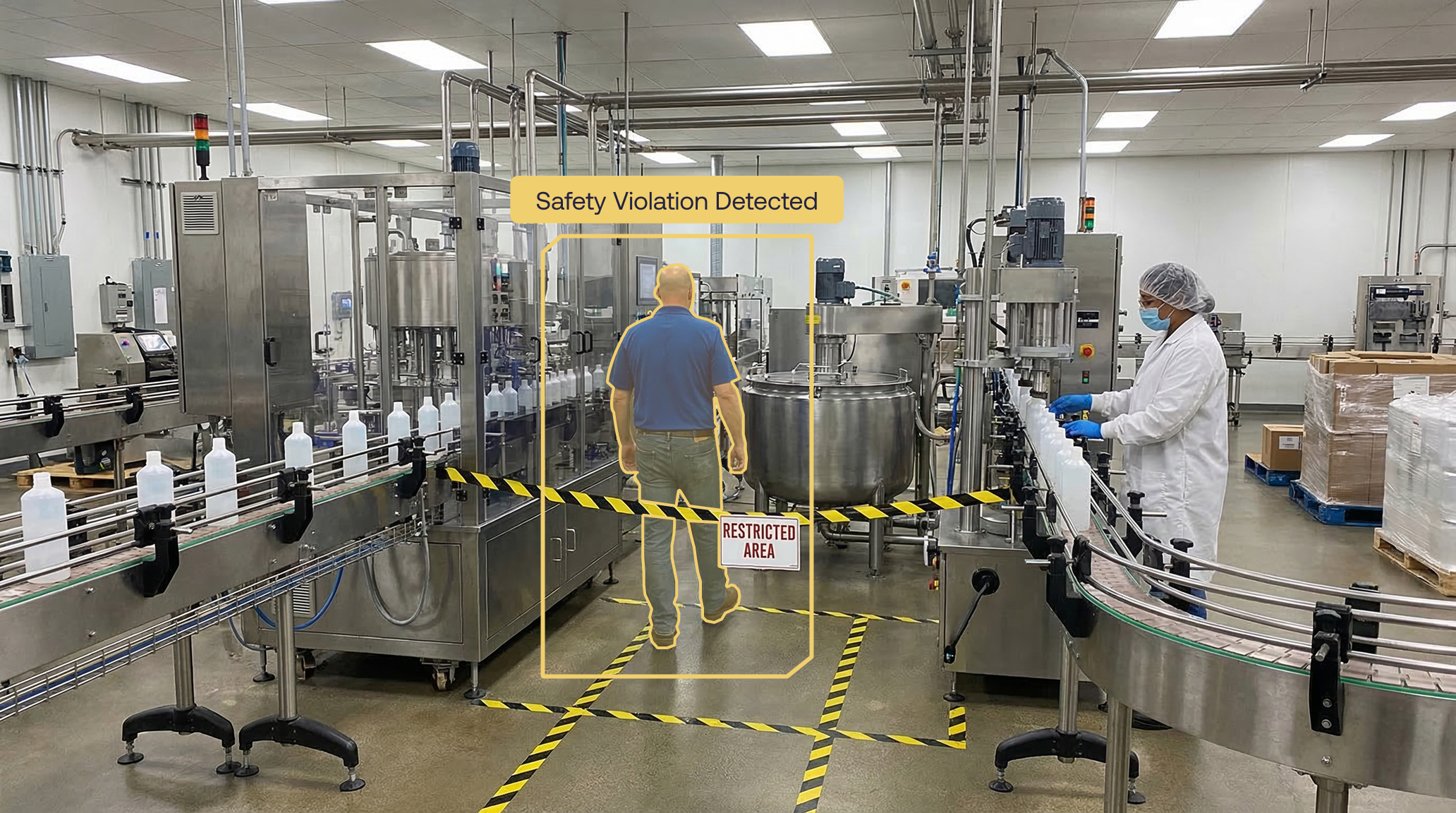
- Someone steps into a restricted zone around a robotics cell, the area supervisor's phone buzzes within seconds, not at the end-of-week review.
- A spill hits the floor, a cleanup task is created before anyone slips on it.
- A person goes down in a low-traffic corner, the system sees it instantly, instead of whenever the next colleague happens to walk past.
- PPE gets verified on every person, in every zone, on every shift, including the night shift, when no one in a safety vest with a clipboard is anywhere on the floor.
- In food and pharma environments, the same layer verifies handwashing and gowning at every entry, which quietly becomes some of the best audit evidence a quality team has ever had.

This is the layer Maneva built ALIS, the AI Line Supervisor agent, for. It runs on the cameras you already own, watches every hour the plant runs, and turns what it sees into immediate action rather than a report finding. Jeff Hetherington's deep-dive on ALIS walks through the four operational roles it fills; this post focuses on the safety layer specifically. Facilities running continuous AI factory safety monitoring have reported health and safety compliance improvements of up to 50%, and industry deployments have documented injury reductions ranging from 30% to 77%.
There's a deeper shift underneath those numbers, and anyone who has run a continuous improvement program will recognize it immediately. TRIR and DART are lagging indicators, they count the injuries after they've happened, the way end-of-line inspection counts defects after they're made. Continuous vision gives safety teams what quality teams have had for decades: leading indicators. Compliance rates by zone and by shift. Near-miss detections you can trend. Hazard dwell times you can put a control limit on. For the first time, you can manage the inputs to your injury rate instead of explaining its outputs in the quarterly review.
Notice the spread in that injury-reduction number, though, because it's telling you something important. The technology performs consistently. The 30% plants and the 77% plants bought similar software. What separated them was everything around it.
What It Takes to Get There
I'll be direct about this part, because it's where these projects are won or lost, and it's the part the sales demos skip.
The floor has to believe the cameras are on their side. This is decided before the first alert ever fires. If workers conclude the system exists to catch people, it dies: alerts get muted, blind spots get found, and the whole thing becomes a monument to distrust. The plants at the top of that 30-77% range did the opposite. They brought operators and worker reps into the design, what gets watched, what explicitly doesn't, who sees the footage, and what it can never be used for. They positioned it as what it actually is: a system that watches conditions, not a system that grades people. And then they proved it with behavior.
Use the data to fix things, visibly. Continuous coverage will show you patterns no walkthrough ever could, PPE compliance sagging at one station every night shift, near-misses clustering at one forklift intersection between 6 and 7 a.m. Treat those findings the way you'd treat a quality deviation: root cause, corrective action, done in the open. When the night crew sees the PPE station relocated because the data showed where compliance actually broke down, instead of a warning taped to the wall, something shifts. The system stops being surveillance and starts being the thing that got the problem fixed. Trust compounds from there, and so does adoption.
Wire detection to response. An alert that lands in a Friday report is just an incident report with better formatting. The deployments that move injury rates measure one thing obsessively: the time between detection and intervention. Seconds matter more than features.
Start where it hurts most, and keep score honestly. One zone with the worst incident history. A real baseline, compliance rates, near-misses, three years of recordables. Then measure. When leadership asks whether it's working, the answer should be numbers from your own floor, not a vendor's slide. In my earlier piece on why the safest floors are also the most productive, I made the case that safety and productivity move together. This is the operational how.
When Finance Asks If It Pays for Itself
It's a fair question, and the math is shorter than most AI business cases. The National Safety Council puts the average medically consulted work injury at $43,000, and that's just the direct layer. Liberty Mutual's research found that every direct dollar generates another $3 to $5 in indirect cost: the overtime to cover the absence, the retraining, the investigation hours, the lost production. So one serious incident is realistically a six-figure event, before your comp premiums adjust and follow you for the next three to five years.
Held against that, a coverage layer running on existing cameras typically pays for itself with the first serious incident that doesn't happen. And there's a quieter second return: the same visibility that catches safety risks also catches process deviations, which is why facilities running this kind of continuous coverage have reported output gains of up to 10%. It turns out a floor that runs safely and a floor that runs well are the same floor.
Everyone Returns Safely Home
Strip away the acronyms, TRIR, DART, EMR, and every safety program in the world exists for one sentence: everyone who walked in this morning walks out the same way. For decades we pursued that with training, guarding, and audits, and it took us a long way. But the incidents still happening are the ones hiding in the hours nobody can watch, and we now have technology that can watch all of them, every shift, without blinking.
The plants moving first on this aren't chasing a technology trend. They've simply concluded that the people on their floors deserve the same continuous attention their products have gotten for years. That feels less like innovation and more like catching up to our own values. If you want to see what that looks like on a live production floor, start at maneva.ai/solutions/health-safety-compliance.