

Change Management Is the Real Barrier to AI Adoption in Manufacturing
AI initiatives in manufacturing rarely fail because the technology is incapable. They fail when leaders begin with the tool instead of a measurable business problem, rely on weak data, or underestimate the organizational change required. This article explains how to define the right problem, prepare teams to work with AI, and use Maneva's VITA and ALIS agents and the Orchestration Platform to turn operational signals into timely action.
Whether your organization is addressing cash-flow constraints, pursuing growth, or strengthening a market-leading position, effective leadership requires openness to tools that can advance measurable business goals.
AI is frequently described as a transformative technology, yet many initiatives still fail to deliver meaningful business value.
This article examines the leadership, data, and change-management disciplines that distinguish successful AI deployments from those that fall short.
Why do AI projects fail in manufacturing?
Most AI projects in manufacturing fail for organizational reasons, not technical ones. The usual pattern is a tool chosen before the problem is defined, data nobody has checked, and a rollout treated as an IT project rather than a change in how people work. Each of those is a leadership decision, which means each one can be fixed.
Start With a Measurable Business Problem
What business problem are you trying to solve, and why is AI the appropriate tool?
If your first question is, "Where can we add AI?" the initiative has started in the wrong place. Effective solutions begin with a clearly defined business problem and a measurable baseline. Without a quantified starting point, leaders cannot evaluate whether an AI initiative improves performance or manage the outcome with confidence.
Remember the maxim: if you cannot describe your problem with a number, you don't know much about it. If you don't know much about it, you don't control it. If you don't control it, it is not business, it is a lottery!
How does Kotter's change model apply to AI adoption?
AI adoption is an organizational change before it is a technology project, so Kotter's framework applies to it directly. Kotter's change model reinforces this point: without a genuine sense of urgency, meaningful change is unlikely to take hold. Introduced in John Kotter's 1996 book Leading Change and refined in later work, the model outlines eight steps organizations can use to make transformation stick, based on research into why many corporate change efforts fail.
The process begins by creating urgency: establishing a clear case for why change is necessary rather than optional. Leaders then form a guiding coalition with sufficient authority, credibility, and cross-functional reach to lead the effort. The next steps are to define a compelling strategic vision and communicate it broadly enough to build commitment rather than mere compliance.
The middle stages focus on removing barriers and building momentum. Organizations enable action by addressing outdated processes, structural constraints, and other obstacles that prevent teams from acting on the vision. They then generate visible short-term wins to establish credibility and strengthen support. Crucially, leaders must sustain acceleration after those early successes rather than declare victory prematurely.
Finally, organizations institutionalize change by embedding new practices into culture, incentives, hiring, and leadership development. This helps ensure that the new operating model endures after the initial initiative loses visibility or sponsorship.
Across all eight steps, the central lesson is that even a sound strategy can fail when leaders neglect the human and organizational dimensions of change: when urgency is weak, the guiding coalition lacks influence, or early wins lead to premature celebration.
Implementing AI represents a significant organizational change. Because the technology often carries concerns about trust, roles, and accountability, leaders may need to address those perceptions before adoption can succeed.
From Reporting Problems to Acting on Them
What differentiates Maneva is its ability to help organizations move from reporting problems to acting on them.
Many operations remain trapped in a recurring cycle: a problem is identified, a report is produced, a meeting is held, and the underlying issue persists. As sensors proliferate, organizations can generate more reports and meetings without creating faster or more effective action.
Maneva connects camera-based insights with existing sensor data so teams can respond when an event occurs. Weekly operating reviews remain important, but their focus shifts from explaining why a problem happened to evaluating how it was resolved and how recurrence can be prevented.
In practical terms, VITA, ALIS, and the Orchestration Platform work as three complementary layers. VITA and ALIS are agents that support immediate operational action when an event occurs, VITA acting on the product and ALIS supervising the people and process, while the Orchestration Platform, powered by Kaizen, Maneva's AI engine, serves as an analytical partner that helps leaders investigate causes, test assumptions, and identify appropriate responses.
Why is asking better questions the new leadership skill?
The Orchestration Platform can be compared to a highly capable early-career engineer: it can solve a well-defined problem quickly, but it does not automatically possess the tacit knowledge that experienced leaders develop over time. Years of management experience create an internal library of assumptions, constraints, and unwritten operating rules. AI needs that context to produce useful recommendations. As a result, a leader's role increasingly includes framing the right questions and supplying the context required to answer them.
Consider a generic question such as, "How can we minimize losses on the production line?" Without additional constraints, an AI system might recommend reducing line speed, or even stopping the line, because that would mathematically eliminate rejects. The output is not useful because the question omits critical operating requirements, such as throughput, customer demand, cost, and service levels.
This challenge extends well beyond a single example. Effective AI adoption requires a fundamental shift in how leaders frame problems, evaluate evidence, and incorporate analytical tools into daily management.
What decisions should leaders keep when AI shares the analysis?
Leaders have traditionally worn two hats: expert analyst and decision-maker. With AI, they retain accountability for decisions while sharing more of the analytical work with the system.
The decision-maker role must remain with you. Your experience includes tacit rules, trade-offs, and contextual knowledge that may never have been written down, and accountability ultimately remains with the leader.
Nevertheless, underestimating this new division of analytical work can put the project at risk. An AI system initially responds only to the explicit rules and information available to it. The Maneva Orchestration Platform reduces that gap by incorporating your standard operating procedures and ISO documentation, giving the agent more context for interpreting your questions.
Data Discipline Comes Before AI
You and your team will also face a larger volume of data, which makes data literacy a core management capability. Leaders must understand what each data set represents, how it was collected, and whether it supports the decision at hand. The goal is not to remove judgment, but to ground judgment more consistently in evidence.
You must become skilled at interpreting what each data set means, including its limitations and the boundary conditions under which its conclusions remain valid. Without that understanding, even a technically sound AI output can point you toward the wrong decision.
The Orchestration Platform is designed to provide reliable analysis, but no AI system is immune to poor questions, incomplete context, or weak data. Before deploying an AI agent, ask three questions:
- Is our data trustworthy enough to support decisions?
- Do we have the discipline to act on insights and sustain continuous improvement?
- Are we prepared to change how work is managed?
If the answer to any of these questions is no, address that gap before introducing AI. If the human part of your process is the bottleneck, apply the Theory of Constraints (TOC): that bottleneck is the one to focus on first.
AI is a mathematical system, but its outputs are not automatically correct. Results depend on the quality of the data, the assumptions built into the model, the context supplied in the prompt, and the judgment used to interpret the answer. Deployment failure is therefore closely connected to project scope, data readiness, governance, and management's ability to adapt to a new operating environment.
What makes AI adoption succeed in manufacturing?
AI transformation succeeds when leaders combine three disciplines: a measurable problem, reliable data, and the willingness to change how decisions are made. Maneva can accelerate analysis and action, but it cannot replace judgment, context, or accountability. The organizations that win with AI will not be those that simply deploy the most technology; they will be those whose leaders define better problems, ask better questions, and build the habits required to act on the answers.
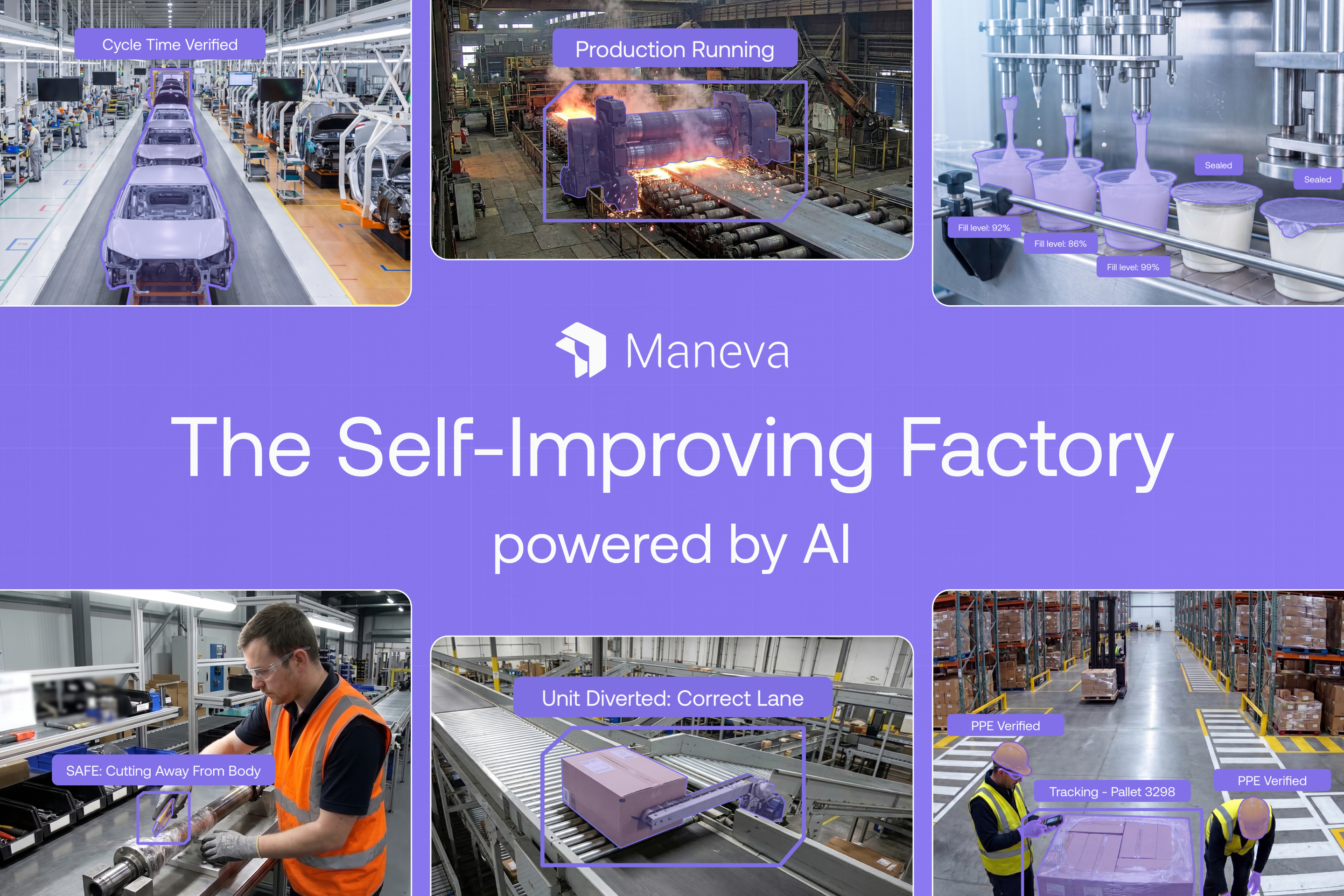
That is what a self-improving factory actually requires: technology that learns every shift, and leaders who keep asking it better questions.
Ready to start with a measurable problem? Book a Demo →