
The Real ROI of AI Quality Control: What Manufacturers Are Actually Saving (With Numbers)
A few months ago, a manufacturing client came to us with a problem that will sound familiar to anyone in manufacturing operations: consumers were opening product on the shelf and finding the seal already broken. A pattern, showing up in complaint after complaint, with no clear answer for where in the process it was happening.
That's the moment most quality teams know well. A defect that's clearly real, clearly recurring, and almost impossible to pin down after the fact, because by the time a complaint reaches you, the unit, the shift, and the line conditions that produced it are long gone.
Here's what that delay actually costs, in numbers most quality budgets don't fully capture: for every customer who complains about a product issue, roughly 26 more experience the same problem and simply switch brands permanently, in 59% of cases. A publicized quality failure can knock 3-5% off brand value on its own. And running underneath all of it, ASQ's benchmark on cost of poor quality puts the number at 10-20% of revenue for a typical manufacturer, most of it hidden in exactly the kind of reactive, after-the-fact investigation this client was running.
Seal integrity specifically carries an outsized share of that risk. The Flexible Packaging Association identifies seal failure as the single leading cause of quality complaints in flexible food packaging, accounting for roughly 32% of all reported cases. An independent study by the University of Lincoln, conducted through the WRAP Retail Innovations Programme, found that close to a quarter of factory seals were already leaking or at risk of failing somewhere in the supply chain, meaning a meaningful share of the problem is typically built in well before a product ever reaches a shelf. And when a seal defect is severe enough and goes unmanaged long enough, the downside isn't hypothetical: a 2021 medical device packaging failure tied to a compromised seal barrier eventually produced thousands of product liability claims and contributed to the manufacturer's bankruptcy by 2024. Most seal issues never approach that scale, but it's a real illustration of why manufacturers treat this defect category differently than a cosmetic scratch or a print smudge.
This is the story of what changed when one client stopped trying to solve seal integrity after the fact.
The Problem Was Never the Defect. It Was the Delay.
Seal integrity issues are a particularly unforgiving category of defect. They're often invisible to a quick visual pass, they can stem from half a dozen upstream causes (pressure, temperature, material variance, equipment wear), and they typically don't surface until a customer complaint comes in weeks later. By then, the root cause investigation is working from memory and incomplete records, while production keeps running the same way the whole time.
That's not a detection problem in the way most people think about it. It's a speed problem. The defect existed on the line the moment it happened. The knowledge of it didn't exist until much later, and in the gap between those two moments, more defective product went out the door. This is the same gap Reggie Figueiredo priced out in his breakdown of the hidden cost of poor quality; this is what closing it looks like on one specific defect.
Building a Model for a Specific Failure Mode
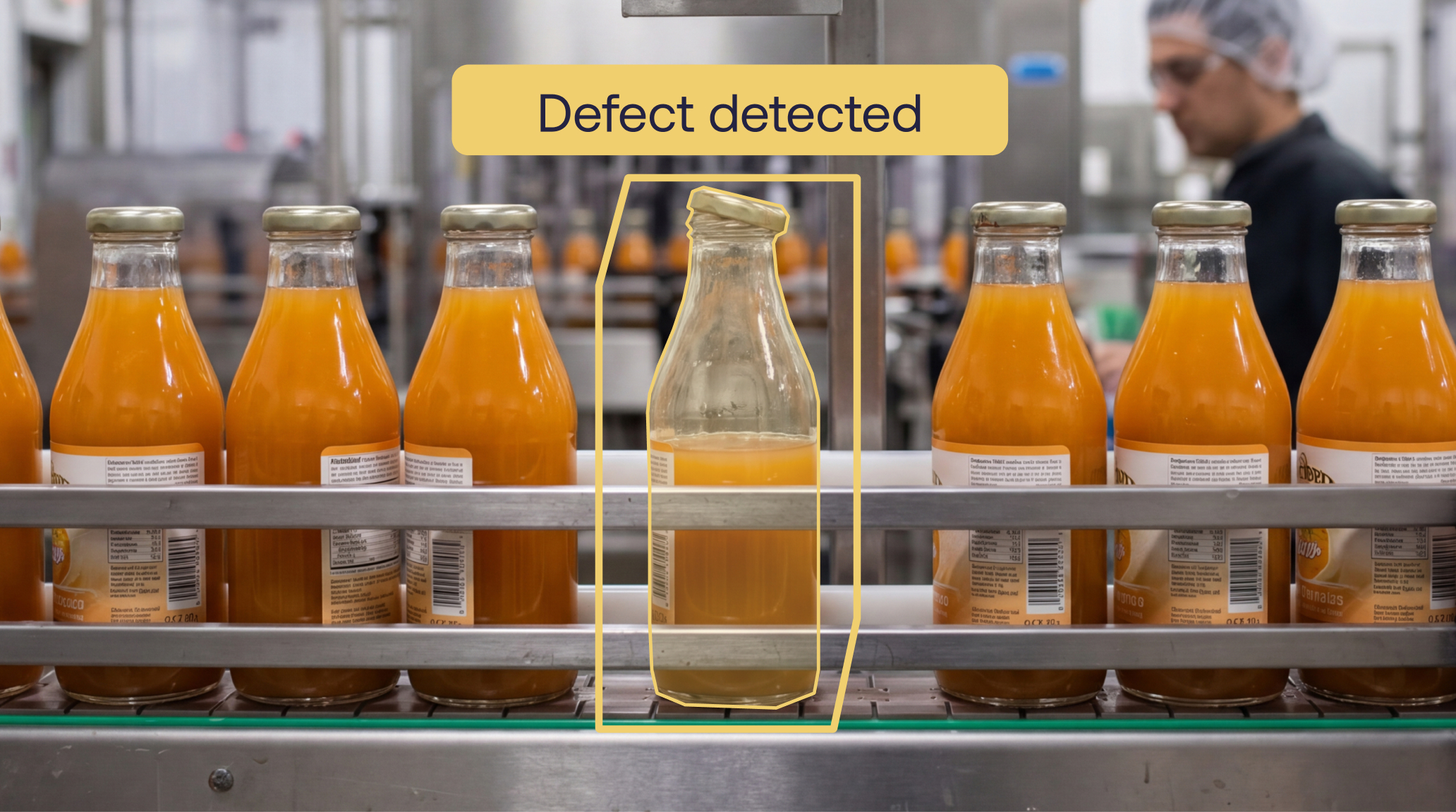
Working with this client, our team didn't start with a generic defect detector. We built a VITA (Video-to-Action AI) agent model trained specifically to recognize different categories of seal integrity failure, the subtle visual signatures that distinguish a proper seal from one that's compromised, across the different ways a seal can fail. That model now runs at 99% accuracy on the seal categories it was built to catch, consistent with the 99.9% inspection accuracy VITA delivers across the wider range of defect types it's deployed against.
The accuracy number matters, but it's not actually the interesting part of this story. What changed operationally is what happened next.
From Detection to Root Cause, Without the Time Lag
Once the model was live, the client had something they'd never had before: the moment a seal defect occurred, they knew about it. Not at the end of the shift. Not when a complaint arrived. In the moment.
That single shift changed the entire response process. Instead of a defect surfacing weeks later as a customer complaint with no context, operations, quality, and maintenance were looking at the same event, on the same line, while the conditions that caused it were still in front of them. Root cause analysis stopped being a forensic exercise reconstructed from memory and started being a live one, backed by a timestamped record.
Within the first six months of running the model, the client saw seal-integrity-related defects reaching the end of the line drop by roughly 70%, and consumer complaints tied to seal issues fall by a comparable margin, consistent with the 60-80% escape-rate reduction range facilities running continuous AI inspection have documented industry-wide. The remaining defects didn't disappear because the seal problem was solved once and for all; they dropped because the feedback loop between detection and correction finally closed fast enough to stop each root cause from repeating itself across an entire shift.
The Part That Doesn't Show Up in a Detection-Rate Number
Here's where the real ROI of this showed up, and it's not one thing, it's the compounding effect of several:
- Fewer consumer complaints, and everything a complaint sets in motion. With 26 unhappy customers behind every one who speaks up, and 59% of them gone for good once they experience a quality issue, every complaint prevented at the seal is worth more than the single unit it represents. A roughly 70% drop in complaints tied to the leading cause of packaging quality complaints isn't a marginal improvement, it's removing the single largest recurring source of quality friction this client had.
- Less time lost to firefighting. Before, a seal integrity spike meant operations, quality, and maintenance pulling into a room to figure out after the fact, with partial information, what happened and whose process was responsible. That's the kind of cost ASQ's cost-of-poor-quality benchmark captures but few plants actually track line by line: investigation labor buried inside a 10-20%-of-revenue number that never gets broken down to the hour.
- A documented process instead of a scramble. Because the detection is happening in real time, the client now has a repeatable RCA workflow that operations, quality, and maintenance all follow the same way, every time. That's the difference between a recurring fire drill and a standard operating procedure, and it's a difference finance actually notices, because it turns unpredictable labor cost into a known, smaller one.
- Fewer repeat defects. Real-time detection means the line can act on a root cause immediately, instead of continuing to run the same way for another shift, another day, or another week while the investigation catches up. That's the direct mechanism behind this client's roughly 70% drop in seal-integrity escapes: it's not that more defects were caught, it's that fewer were produced in the first place.
- Less time on product holds. When a quality issue is suspected, everything downstream of it often gets held pending investigation. That's inventory sitting, labor tied up, and potential rework or scrap depending on what the investigation finds. Cutting the time it takes to identify and resolve the root cause cuts the size and length of that hold directly.
- A searchable record instead of institutional memory. Every detection comes with a timestamped image and video record. When quality needs to investigate a pattern or answer a question from a customer or an auditor, they're pulling a specific clip from a specific moment, not asking three people what they remember about a shift six weeks ago.
Why This Adds Up to More Than the Sum of Its Parts
Each of these on its own is a modest efficiency gain. Together, they change the shape of the cost curve. ASQ's own framework splits the cost of quality into prevention, appraisal, and failure costs, and the traditional model treats each failure as a cost paid once, after the fact: inspection cost, rework cost, complaint cost, investigation cost, often paid separately and paid late. What this client's experience shows is that when detection, root cause, and documentation happen in the same moment instead of in sequence over weeks, those costs don't just get smaller individually, they stop compounding into each other. A complaint that never happens doesn't generate an investigation. An investigation that takes an hour instead of a week doesn't tie up three departments. Prevented recurrence doesn't need a hold.
The ROI Conversation Worth Having
When manufacturing leadership asks what this is actually worth, the honest answer is: model it against your own recurring defect categories, not against an industry average. Take the defect type that generates the most complaints or the most cross-functional firefighting time, and ask three questions. How many hours does your team currently spend reconstructing what happened after the fact? How much product sits on hold, on average, while that reconstruction happens? And how many of those events are recurrences of something you'd already seen before, but couldn't act on in time to stop it happening again?
Those three numbers, priced against a real hourly cost and a real hold-inventory value, are usually where the business case actually lives, well before you get to the detection accuracy number that tends to lead these conversations. And with ASQ pricing the cost of poor quality at 10-20% of revenue for most manufacturers, even a partial reduction in one recurring category is rarely a marginal number.
Where to Start
Pick the defect category that's generating the most consumer complaints or the most repeated cross-functional scrambling, the one everyone on your quality team already knows by name. That's usually the highest-leverage place to build a model, because the cost of the current delay is already visible; you just haven't priced it yet. It's the same reason manual visual inspection keeps missing these defects, and why sampling can look disciplined while letting the real defects through.
The manufacturers seeing the biggest return from AI quality control aren't necessarily the ones with the highest detection accuracy number. They're the ones who've closed the gap between when a defect happens and when someone can act on it, because that gap, not the defect itself, is where most of the cost was hiding all along.
If you want to see what real-time root cause looks like on a live production line, start at maneva.ai/solutions/quality-assurance.